
Knauf Radiant Barrier Installation: The San Diego Owner’s Guide
We install Knauf radiant barrier products throughout San Diego County, with most residential installations running $800 – $1,800 depending on attic square footage and accessibility. We stock Knauf-compatible radiant barrier materials on our trucks, so same-day and next-day installation is available across most San Diego neighborhoods. You’ll usually know something’s off when your upstairs rooms hold heat well into the evening in July, or when the attic feels like a sauna within minutes of sunrise despite a ventilated roof.
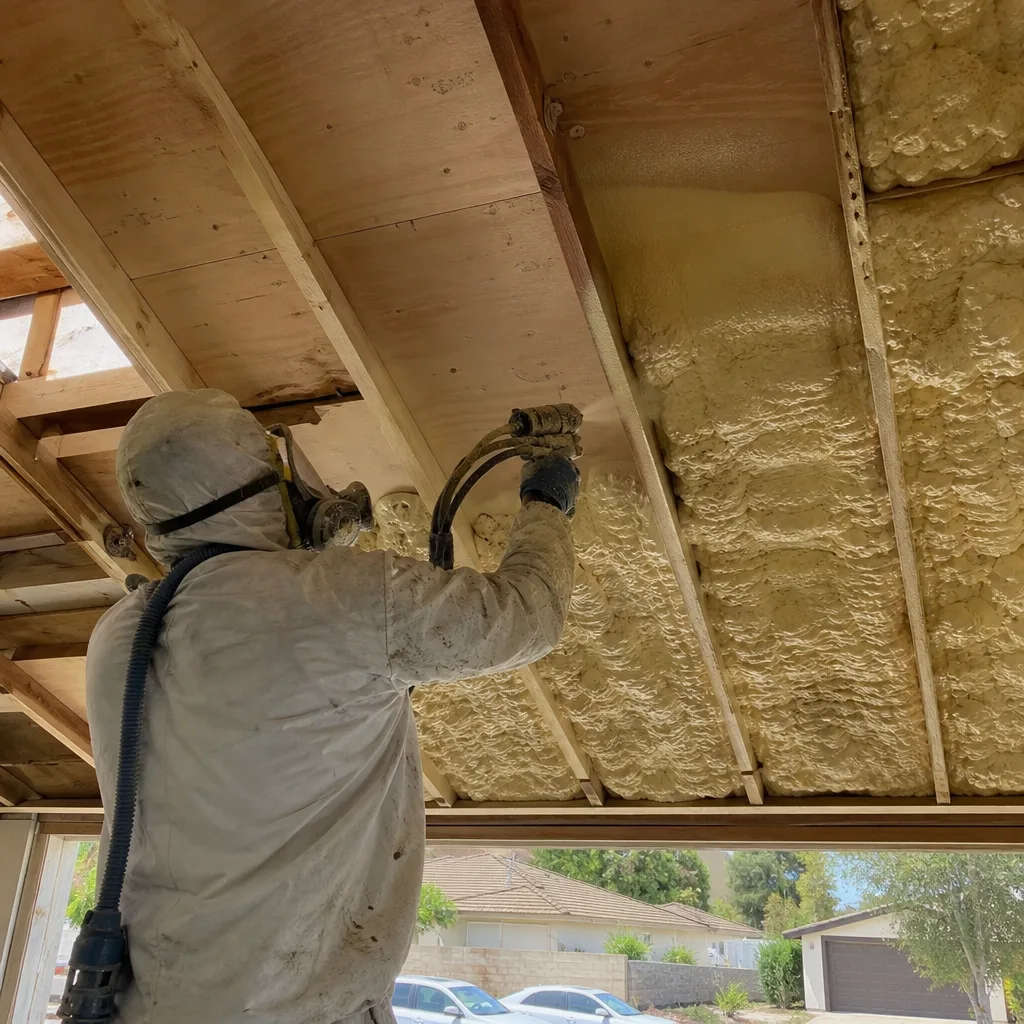
Radiant barrier isn’t insulation in the traditional sense. It’s a reflective aluminum surface that bounces radiant heat back toward the roof deck instead of letting it soak into your attic air and then through your ceiling. Knauf builds theirs with a reinforced scrim layer, which matters in San Diego because coastal moisture and the dry inland heat both punish flimsy barriers differently. We’re an independent San Diego installer, not affiliated with Knauf corporate, which means we’ll tell you straight when another product fits your house better.
Which Knauf Models This Applies To
We install the full Knauf radiant barrier line, including Knauf Energy Shield, Knauf Insulation Radiant Barrier, and the perforated and solid variants of their reflective foil. The model number is printed along the edge of the roll or on the facing label. If you’re looking at a partially installed barrier, measure the foil thickness with calipers: Knauf’s standard residential foil runs 0.000285 inches thick for the aluminum layer, with the scrim-reinforced versions hitting closer to 0.0005 inches total. That spec matters because cheaper radiant barriers use thinner foil that tears when you staple it and degrades faster under San Diego attic temperatures, which routinely hit 130°F to 150°F in August.
There’s an OEM-vs-aftermarket decision here, and for radiant barrier specifically, the aftermarket options are often perfectly fine. Reflectix makes a comparable reflective foil that we also stock and install, and it performs functionally identically in most San Diego attics. The real compatibility question isn’t brand, it’s perforation: if your roof sheathing isn’t fully vented, the barrier needs to be perforated so moisture doesn’t trap against the decking. Installing solid foil on an under-ventilated deck causes condensation, and in San Diego’s marine-layer-adjacent neighborhoods like Point Loma and Ocean Beach, that becomes visible mold staining inside two seasons.
Signs Your Knauf Radiant Barrier Installation Is Failing
Here’s what we see most often on radiant barrier jobs across San Diego:
- Sagging or drooping foil between rafters. Staples pull loose over years of thermal expansion and contraction. San Diego’s temperature swings aren’t extreme, but the reroofing cycle means the barrier takes incidental abuse. Sagging reduces the reflective air gap, which is the entire mechanism that makes the barrier work.
- Visible dust film dulling the shiny surface. Radiant barriers lose effectiveness when the aluminum face gets coated in dust. Attics in East County get genuinely dusty from Santa Ana winds, and a dull barrier can lose 20 – 30% of its reflectivity. A wipe-down sometimes restores it, but if the foil is creased or torn, replacement sections are the fix.
- Tears near access hatches and storage areas. The point where homeowners move boxes, holiday bins, or even just themselves through the attic is where foil fails first. A torn radiant barrier isn’t dangerous, but once air moves freely through the tear, the reflectivity advantage disappears around that cavity.
- Condensation staining on the roof decking above the barrier. This one’s a ventilation problem, not a barrier wear problem. You’ll see dark water marks on the plywood visible from below, and it means the barrier wasn’t perforated or the venting changed during a reroof. This needs correction, not just replacement.
- Upstairs rooms won’t cool below 78°F in summer despite a newer AC. The classic symptom pattern. If your HVAC is sized correctly but the second floor cooks from 3 PM to 9 PM, the ceiling plane is absorbing heat from a hot attic, and the barrier or attic insulation isn’t doing its job.
Replacement Cost & What’s Included
For a typical San Diego attic between 1,200 and 2,000 square feet, a full Knauf radiant barrier installation runs $800 – $1,800. That’s materials, labor, stapling, seam taping, and cleanup included. Smaller attics under 800 square feet land closer to $600 – $900, and larger or complex attics with low clearances, cathedral sections, or heavy storage can push past $2,000. We give you a written price before any work starts, so you’ll know the number before we open the attic hatch.
Here’s the line-item breakdown for the way we price a standard San Diego installation:
- Knauf radiant barrier material: $0.25 – $0.45 per square foot, depending on perforated vs solid and reinforcement
- Labor and installation: $0.45 – $0.70 per square foot
- Prep and cleanup: included, never a line item
Every installation carries our 365-Day Done Right Promise in writing. If the barrier sags, tears at the staples, or fails within a year, we come back and fix it free. No charge, no argument, and if that repair fails, a second visit is free too.
DIY or Call Us?
Radiant barrier installation is one of the more approachable attic projects you could attempt. The material is light, it doesn’t itch like fiberglass, and there’s no high-voltage or gas involvement. What gets DIYers in San Diego is the attic heat itself: working on a ladder in a 140°F attic for two hours is genuinely dangerous. We see heat exhaustion cases every summer. The second failure point is getting the air gap right. Stapling foil flat against decking kills its performance, and getting consistent 1-inch spacing across a whole attic requires patience and the right fastener technique.
You can cheaply check the condition of your existing barrier yourself: pop the access hatch, shine a flashlight across the foil, and look for dulling, sagging, or tears. If the barrier looks intact and reflective, the issue may be elsewhere (attic insulation depth, duct leaks, ventilation). If you have a full failure, call us at (619) 793-3676 and we’ll get eyes on it same day. You’ll get a written price before anything starts.
FAQs
Expect 10 to 20 years from Knauf radiant barrier in San Diego attics. The aluminum itself doesn’t rot, but dust accumulation, staple pull-out, and incidental damage from storage or HVAC work are what degrade it. Coastal homes tend to see more condensation risk, while inland attics see more dust and heat cycling. If your barrier is over 15 years old and showing sagging or heavy dusting, replacement starts looking cost-effective.
Sometimes. Small tears under a few square feet can be patched with foil tape, and localized sagging can be re-stapled. But if more than about 20% of the foil surface is dulled or torn, the materials cost of piecemeal repair approaches the cost of a clean replacement. Call (619) 793-3676 and we’ll tell you honestly which side of that line you’re on.
Most San Diego homes take half a day to one full day depending on attic size and geometry. Low-slope attics with tight clearances run on the longer end because we’re moving carefully across joists. You don’t need to leave the house, and we’ll send you before-and-after photos when the work is done.
Yes. Our San Diego trucks carry Knauf radiant barrier rolls in both perforated and solid variants, plus the foil tape and fasteners. If you schedule a diagnosis and your attic needs a full install, we can typically start the same day without a trip back to a supplier. We also carry Reflectix for applicable jobs.
Call (619) 793-3676 and we’ll get your attic measured, priced, and scheduled. You’ll talk to a person, not a voicemail, and that person can give you real numbers over the phone.
Written by Chase Whitaker, Owner, Laurel Attic Insulation San Diego at Laurel Attic Insulation San Diego, serving San Diego and nearby areas.