
Johns Manville Crawl Space Encapsulation: The San Diego Owner’s Guide
We install and service Johns Manville crawl space encapsulation systems throughout San Diego, with most partial repairs running $1,200-$2,800 and full encapsulation replacements typically landing between $4,500-$9,500 depending on square footage and liner condition. Most homeowners call us after noticing a musty smell creeping up through the floorboards or seeing a floor vent register stained with condensation. The liner itself doesn’t “break” like a water heater – it usually fails at seams, fasteners, or where a tear starts small and the humidity does the rest.
Which Johns Manville Models This Applies To
Johns Manville sells crawl space encapsulation as a system rather than a single SKU, which means you won’t find a model number stamped on a sticker the way you would on a furnace. The core product lines we work with are the Johns Manville CrawlSpace liner series (typically 10-mil, 12-mil, or 20-mil reinforced polyethylene) paired with JM’s accessory line: seam tape, butyl mastic, masonry fasteners, and their vapor barrier termination strips. If you’ve got an older install from 2015 or earlier, you’re likely working with the 10-mil liner, which frankly doesn’t hold up as well in San Diego’s soil conditions as the newer 20-mil product.
A compatibility gotcha worth knowing: Johns Manville’s seam tape is engineered to bond specifically with their liner’s surface chemistry. We’ve seen homeowners patch a JM liner with generic poly tape from a big-box store, and it peels within months because the adhesive can’t bond to the fire-retardant coating on the JM product. When we repair a Johns Manville liner, we use JM’s own tape and mastic, not a knockoff. We’re an independent San Diego contractor, not affiliated with Johns Manville, but we stock their materials because after years of working with eight manufacturer brands, we’ve learned when OEM is the only honest call.
Signs Your Johns Manville Crawl Space Encapsulation Is Failing
- Humidity in the crawl space reads above 60% on a hygrometer. A properly encapsulated San Diego crawl space should stay in the 40-55% range. When the JM liner has a seam separation, moisture from the soil re-enters and the numbers climb even without visible standing water.
- Floor feels cold in winter, or wood flooring has started cupping. Cupping means moisture is moving upward through the subfloor. In San Diego neighborhoods like Point Loma and Mission Hills where homes sit close to the water table, this is often the first sign homeowners notice before they ever look under the house.
- Musty odor that gets worse when the furnace kicks on. Your HVAC pulls air from the crawl space through gaps around ducts and plumbing penetrations. If the liner has failed, that air carries organic smells straight into your living space.
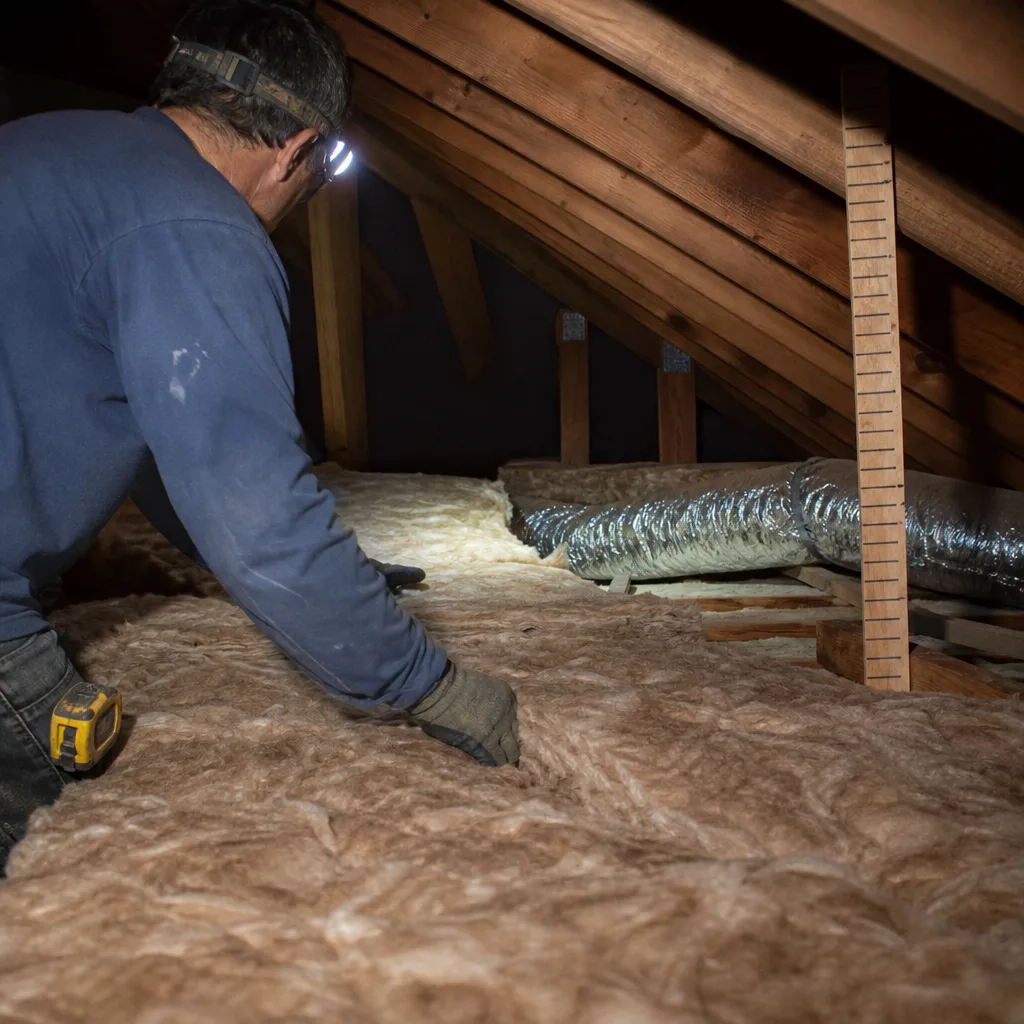
- Insulation bats hanging or falling from the floor joists. Johns Manville’s crawl space liner often pairs with JM batt insulation in the joist bays. When the liner fails and humidity rises, the batts absorb moisture, get heavy, and start sagging. Once they sag, their R-value – the number that measures how well insulation resists heat flow – drops hard.
- Visible condensation on ductwork or plumbing pipes in the space. In San Diego’s mild winters, an unencapsulated or failed-encapsulation crawl space creates a perfect dew-point environment. Condensation on ducts isn’t a comfort problem, it’s a mold invitation.
Replacement Cost & What’s Included
In San Diego, partial encapsulation repair – patching a seam, re-taping a corner, re-fastening a section that’s pulled away from the foundation wall – typically runs $1,200-$2,800 for most homes we see from El Cajon up to Oceanside. Full liner replacement on a standard 1,200-1,800 square foot crawl space usually lands between $4,500-$9,500 installed, with cost driven by liner thickness (10-mil vs 20-mil), how many foundation piers are involved (each pier eats material and labor), and whether we’re also removing failed insulation and re-insulating with fresh JM batts.
Every quote from us is a written price before we start, not a ballpark that changes when we get under the house. The parts line item is transparent – you’ll see exactly what the Johns Manville liner, tape, mastic, and fasteners cost – plus labor, all upfront. And every repair we do includes our 365-Day Done Right Promise covering workmanship for a full year, with a free second visit if anything fails.
DIY or Call Us?
Crawl space encapsulation isn’t a high-voltage job like an electrical panel, but it’s also not a weekend project for most San Diego homeowners. The honest split: you can safely inspect your own crawl space with a flashlight and a moisture meter, and you can spot a failed seam or a sagging liner. What goes wrong with DIY repairs is what we described above – using the wrong tape, not addressing the moisture source before re-lining, or not fastening the liner correctly to the foundation wall, which lets soil moisture wick right back in. Working in a crawl space also means tight quarters, low light, and sometimes old wiring or pest activity. If you’d rather not spend your Saturday under the house with a headlamp and a roll of mastic, call us at (619) 793-3676 – we’ll give you a written price and get it done with photo proof so you can see the finished work without going down there yourself.
FAQs
A properly installed Johns Manville 20-mil liner in San Diego typically lasts 15-20 years, while the older 10-mil product more realistically gives you 8-12 years in our soil and humidity conditions. San Diego’s coastal moisture and occasional heavy rain years shorten liner life compared to drier inland climates like Arizona or Nevada. If you’re seeing signs of failure before year 10, the installation itself was likely the weak point, not the material.
Yes, if the tear is localized and the rest of the liner is still glued to the foundation walls and piers. We patch tears using JM’s own seam tape and mastic, which bonds with the liner’s surface chemistry. If the liner is brittle, pulling away in multiple spots, or the original installation taped seams are failing across the space, replacement is the better financial call – patching a failing system piece by piece costs more in the long run. Call (619) 793-3676 and we’ll tell you which camp your crawl space falls into, free estimate included.
A targeted patch repair is usually half a day. A full liner replacement on a standard San Diego home takes one to two days, depending on pier count and whether we’re also pulling old insulation. We’ll tell you the timeline in writing with your quote, and you’ll get live tracking on arrival day so you know when our crew is pulling up.
Yes. Our trucks carry Johns Manville 12-mil and 20-mil liner stock, JM seam tape, butyl mastic, and termination strips for standard repairs on the first visit. We also stock Reflectix products for specific reflective applications where they make sense. If your project calls for something outside our normal truck inventory, we’ll have it ordered and scheduled without dragging out the timeline.
If you’re under your house with a flashlight wondering what you’re looking at, call us – we’ll help you figure out what’s going on and whether it’s a repair or a full replacement. Good insulation doesn’t announce itself – you just stop noticing your energy bill. A failed liner is a different story, and the sooner you catch it, the cheaper the fix. Reach us at (619) 793-3676 for a free estimate from Chase Whitaker and our San Diego crew.
Written by Chase Whitaker, Owner, Laurel Attic Insulation San Diego at Laurel Attic Insulation San Diego, serving San Diego and nearby areas.