
Icynene Spray Foam Insulation in San Diego: What to Know First
Icynene spray foam insulation issues in San Diego typically cost between $400 and $3,800 to address, depending on whether you’re dealing with a localized re-foam, a rim joist repair, or a full open-cell removal and reapplication. Most jobs we schedule within 3 to 5 business days, and we’ll give you a written price before any material leaves the truck. If you own an Icynene-insulated home anywhere from Chula Vista to Carlsbad and something’s off, call us at (619) 793-3676 and we’ll tell you over the phone whether it’s urgent or can wait.
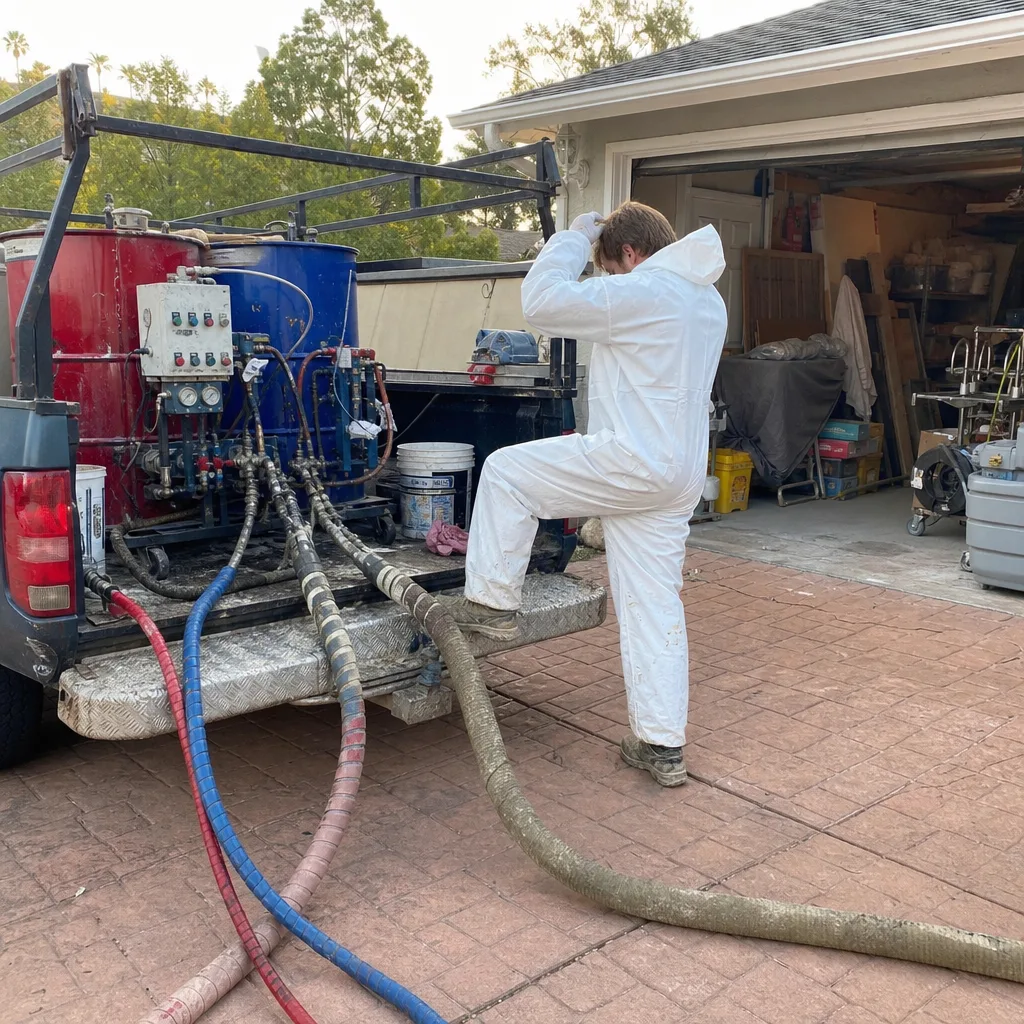
This page is for San Diego homeowners who have Icynene spray foam in their attic, walls, rim joists, or roof deck and need straight answers about what’s failing, what it costs to fix, and who can actually do the work right. We’re an independent Icynene service provider, not a factory rep, so our only interest is the honest fix, not preserving a warranty that may or may not apply.
How Icynene Products Fail – and How We Fix Them
We see the same failure patterns across San Diego’s coastal and inland neighborhoods, and they tend to track with product line. Here’s what actually goes wrong with Icynene spray foam and how we correct it:
- Icynene Classic (open-cell) shrinkage and detachment. The Classic open-cell line was reformulated years ago, but older installs, especially in La Mesa, Lemon Grove, and Clairemont homes built from 2005 to 2012, sometimes show the foam pulling back from roof decking or wall studs by a quarter to a half inch. That gap becomes a thermal bypass: hot attic air slips around the foam and your AC runs harder. Minor voids we inject with low-expansion foam matched to the existing density. When the detachment is widespread, sectioned removal and a full re-spray with a modern open-cell product is the only fix that lasts.
- ProSeal and ProSeal LE closed-cell overspray on can lights and vents. Closed-cell foam expands with force. When an installer didn’t box out recessed fixtures or bath fans, the foam can encase the housing, trap heat, and trip thermal cutoffs. That’s why a bathroom fan that used to run for ten minutes now cycles off in two. We cut back the foam mechanically, never chemically, to avoid damaging the fixture or the surrounding foam’s air seal. Heat buildup inside a can light is a fire risk, so this one we always flag as urgent.
- Classic Max and MD-C-200 lower-density open-cell absorbing coastal moisture. In Point Loma, Ocean Beach, and Imperial Beach homes where marine air pushes in, open-cell foam that wasn’t protected by a proper vapor retarder can hold moisture against roof sheathing. The symptom is a musty smell in the attic and, in older homes, darkened areas on the plywood deck. We assess whether the fix is spot drainage, a supplemental ventilation correction, or removing the affected foam and re-spraying with a closed-cell product that handles humidity better.
- Rim joist bays with Icynene Lite or similar low-rise formulas that never sealed. Rim joists (the band board where your floor framing meets the foundation wall) are the most common place we get called out for energy loss. In San Diego’s 1950s through 1970s tract homes, especially in Allied Gardens, San Carlos, and Serra Mesa, the foam sometimes shrank back from the sill plate within the first few years. Cold air from the crawlspace leaks into the floor system, and the fix is straightforward: clean the bay, flash any moisture, re-foam, and move on. Most rim joist jobs take our crew under a day.
- Roof deck re-foams where the original Icynene was applied too thin. During the 2009-2013 building boom, some San Diego subdivisions got the minimum spec for open-cell roof decks, often 5 to 6 inches when 8 to 10 was needed for our climate zone. The result is uneven attic temperatures and rooms over the garage that never cool down. We re-insulate to the correct depth, and we verify the R-value with photos of the depth gauge before we call the job done.
Our Icynene Spray Foam Insulation Process
Here’s how a typical Icynene job goes from your first call to the invoice, with no surprises in between:
- 1
You call (619) 793-3676. A live person answers, day or night. We’ll ask what you’re seeing: higher bills, a draft, a damp spot, a room that won’t hold temperature. Then we’ll tell you honestly if it sounds like an insulation problem or something else.
- 2
We come out and look. A background-checked, uniformed technician arrives at a live, trackable time, not a four-hour window. For Icynene work, that means checking foam depth with a gauge, probing for detachment, and using a thermal camera to find thermal bypasses.
- 3
You get a written price before anything starts. No door-step number changes. The quote covers material, labor, cleanup, and disposal. If you approve it, we do the work exactly as priced.
- 4
The repair or re-spray. We match the right product to the condition. When Icynene products are the right call, we use them. When another material fits better, we’ll tell you and why. We also work with Reflectix radiant barrier where a reflective layer is needed alongside foam.
- 5
We test it. Depth verification, adhesion checks, and before-and-after photos sent to your phone. You see what got done, not just a final bill. If anything’s off, our 365-Day Done Right Promise kicks in and we fix it at no charge.
What Icynene Spray Foam Insulation Costs in San Diego
Prices depend on the scope, but here’s where most Icynene-related work lands in San Diego:
- Rim joist spray foam (typical 1,200 – 1,800 sq ft home): $950 – $2,200 for all exposed bays, depending on accessibility and whether old fiberglass needs removal first.
- Attic roof deck spot repair (voids, detachment): $400 – $900 for localized injection and sealing.
- Full open-cell attic re-spray (1,000 – 1,500 sq ft): $3,200 – $5,500 including removal of failed existing foam.
- Garage ceiling spray foam: $1,200 – $2,800 depending on square footage and whether you want open-cell for temperature or closed-cell for added structural strength.
- Closed-cell spray foam for wall cavities (existing construction): $2,800 – $6,000, often done room by room when walls are already open during a remodel.
What moves the price: whether the existing foam can be kept, access (crawlspace versus open attic), foam depth needed, and whether you need closed-cell, which costs more per board foot but insulates better per inch. Every quote is written and fixed before we start. Call (619) 793-3676 for an exact number on your job.
Why San Diego Homeowners Call Laurel Attic Insulation San Diego for Icynene Work
Chase Whitaker, our owner, trained in building construction and weatherization at Los Angeles Trade-Technical College and has been installing and upgrading insulation for over ten years. His crew has worked everything from Hillcrest bungalows to newer builds out near Miramar. That matters because San Diego housing stock is all over the map: 1920s Craftsman attics in North Park, 1970s track homes in Clairemont, 1990s stucco boxes in Scripps Ranch. Icynene behaves differently in each, and we’ve seen just about every version of it fail. As an independent Icynene service provider, we’re not tied to one repair path. If your foam needs a small fix, that’s what we recommend. If it needs full replacement, we’ll tell you that too. Every job comes with our 365-Day Done Right Promise, a written guarantee, and a free second visit if the repair fails. Good insulation doesn’t announce itself, you just stop noticing your energy bill. We’ll get you there.
FAQs
Is it cheaper to repair or replace failed Icynene spray foam? Spot repairs for voids and small detachments run $400 to $900, while full removal and re-spray of an attic roof deck usually runs $3,200 to $5,500. The deciding factor is how much of the foam has pulled away or absorbed moisture. A thermal camera tells us fast whether a target fix will do it or whether you’re throwing money at a bigger problem. Call (619) 793-3676 and we’ll help you figure out which bucket your home falls into.
Can you fix Icynene foam without ripping out my whole attic? In many cases, yes. Localized voids, rim joist shrinkage, and spot detachment can be corrected without a full removal. We cut back, inject, or re-spray the affected area and verify the fix with photos and depth gauges.
Does Icynene’s manufacturer warranty cover your repair work? Icynene’s warranty covers the material when installed by an authorized dealer under specific conditions, but we’re an independent Icynene service provider, so we don’t operate under their program. Our work carries our own 365-Day Done Right Promise, in writing, on every job.
How fast can you get to my Icynene problem in San Diego? Most jobs we schedule within 3 to 5 business days. If you’ve got a can light that shuts off, a smell in the attic, or foam pulling away from the roof deck, we treat it with urgency and will tell you over the phone whether it can wait a few days or needs something sooner. Call (619) 793-3676.
Do you only use Icynene products for repairs? No. We stock materials from eight leading brands, including Owens Corning, Rockwool, CertainTeed, Demilec, and Icynene, plus Reflectix for radiant barrier applications. We match the material to the condition, not to whatever is already on the truck. You’ll always know what we’re using and why before the work starts.
Written by Chase Whitaker, Owner, Laurel Attic Insulation San Diego at Laurel Attic Insulation San Diego, serving San Diego and nearby areas.