
GreenFiber Attic Insulation: The San Diego Owner’s Guide
We stock and install GreenFiber attic insulation throughout San Diego, with most blown-in jobs running $900 to $2,400 depending on square footage and the R-value you’re targeting. Same-day installation is available in most cases, and every job starts with a written price before a single bag gets opened. Most homeowners discover their GreenFiber insulation has failed the hard way: an energy bill that keeps climbing, a second floor that won’t hold temperature, or visible settling when they poke their head up through the attic hatch.
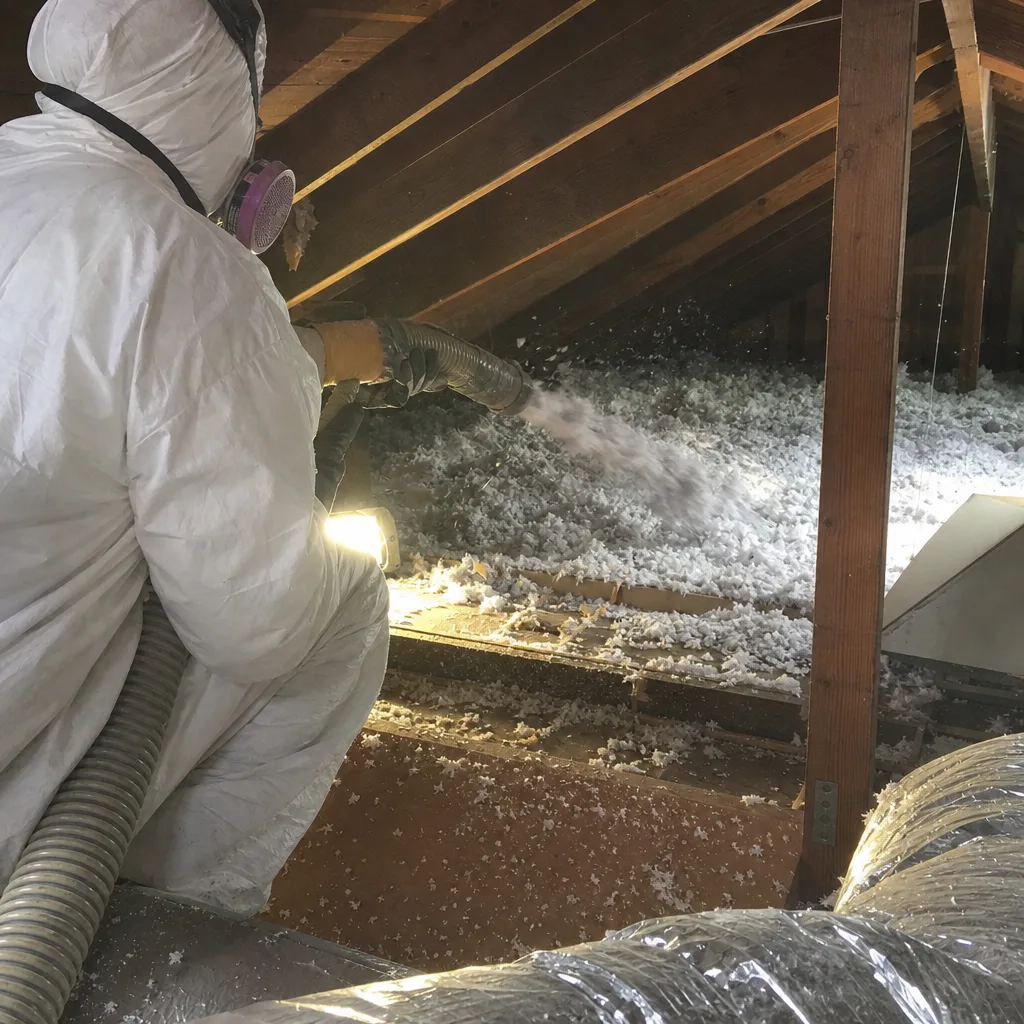
GreenFiber is a cellulose product, which means it’s made from recycled paper treated with borate for fire and pest resistance. That treatment does a lot of work in San Diego’s climate, but the material itself settles over time, and moisture intrusion from our coastal marine layer can accelerate degradation faster than most owners expect.
Which GreenFiber Models This Applies To
GreenFiber sells blown-in cellulose under a few product lines: Sanctuary, Cocoon, and Insulmax. All three are loose-fill products installed with a blower machine, not batts or rolls. The version you have matters less than the condition and depth, but there’s one compatibility gotcha we see regularly in San Diego: older GreenFiber installs from the early 2000s often used a lower-density formulation that settles more aggressively than current Sanctuary product. If your attic has original GreenFiber from that era, you’re likely under-insulated even if no one touched it.
The real question is whether to top off, remove, or replace. We’re an independent service provider, not affiliated with GreenFiber directly, so our recommendation is driven by what’s right for the house. In most attics, the smart move is topping off with fresh GreenFiber to reach R-38 or R-49, which is what current California energy code pushes for in San Diego’s mild climate zone. We pull the old stuff only when there’s rodent saturation, water damage, or mold.
Check the attic hatch or the top plate of an exterior wall for a card or stamp. If you can’t find one, measure the depth. Eleven to twelve inches of settled GreenFiber typically gives you around R-38 to R-42. Anything under eight inches means you’re running at roughly half the insulation you should have.
Signs Your GreenFiber Attic Insulation Is Failing
- Hot bedrooms above the garage or on the second floor. This is almost always insufficient or settled insulation. Cellulose compacts under its own weight, and after 8 to 10 years in San Diego, the effective R-value can drop by 20 to 30 percent from original install depth.
- Uneven coverage you can see from the hatch. If you shine a flashlight and see peaks and valleys or bare patches near the eaves, the original install was likely uneven or the material has shifted from foot traffic or rodents.
- Higher-than-expected energy bills during mild months. San Diego’s climate is forgiving, so when your AC or heat runs noticeably harder in April or November, that’s insulation underperforming, not weather extremes.
- Damp, musty odor from the attic. Cellulose absorbs moisture. Once wet, GreenFiber clumps, loses R-value, and can hold water against roof decking. Our coastal neighborhoods from Point Loma to Ocean Beach see this more than inland areas like Santee or El Cajon due to marine layer humidity.
- Visible dust or cellulose particles around can lights or attic access points. This usually means the material has broken down mechanically, often from repeated air-pressure changes or past pest activity, and it’s blowing into the living space.
Replacement Cost & What’s Included
Here’s what you can expect to pay for GreenFiber attic insulation in San Diego right now:
- Top-off to R-38 (600 to 1,000 sq. ft. attic): $700 to $1,100
- Full removal and reinstall to R-38 (same footprint): $1,400 to $2,200
- Top-off to R-49 (600 to 1,000 sq. ft. attic): $900 to $1,500
- Full removal and reinstall to R-49: $1,800 to $2,700
Price drivers are attic footprint, current depth, access difficulty (low-slope roofs in places like Normal Heights eat up labor time), and whether we’re removing old material or working over the top of it. Every quote includes the GreenFiber material, machine time, labor, and cleanup. You get a written price before work starts under the Relay Visibility Guarantee, a written 365-Day Done Right Promise on workmanship, and a free second visit if anything’s not right. No add-on surprises at the door.
We also stock Reflectix for radiant-barrier applications under roof decking, which pairs well with cellulose in attics that get direct sun load in neighborhoods like Mira Mesa or Chula Vista.
DIY or Call Us?
You can absolutely pull the attic hatch, measure your current depth, and check for visible problems like wet spots, bare patches, or rodent droppings. In fact, Chase Whitaker will tell you to do that before you spend a dollar, because knowing current depth and condition tells us exactly what we’re walking into. What you shouldn’t do is rent a blower machine and dump GreenFiber into an attic without addressing ventilation baffles, air sealing, and can-light clearances. That’s where DIY installs in San Diego go sideways every summer: insulation packed against recessed lights creates a fire risk that no one notices until it’s too late.
Blown-in cellulose installation is not dangerous work when done right, but the details matter. Soffit vent blocking, eave baffles, and depth marking with a proper ruler are the difference between a job that performs for 15 years and one that cooks your attic. Call us at (619) 793-3676 and we’ll send someone who knows what GreenFiber should look like when it’s done correctly.
FAQs
GreenFiber cellulose typically performs well for 15 to 20 years in San Diego, but most attics need a top-off around the 10-year mark as settling reduces effective R-value by roughly 2 percent per year. Coastal humidity in neighborhoods like Pacific Beach or La Jolla can shorten that lifespan if ventilation is poor. Call (619) 793-3676 for a free depth check.
Yes, in most cases we top off settled or uneven GreenFiber rather than removing it entirely, which is the most cost-effective repair. Removal only makes sense when there’s water damage, heavy rodent contamination, or mold, and that’s a call we make with you after looking at the attic. Estimates are free, so call (619) 793-3676.
A typical top-off in a San Diego home takes 3 to 5 hours from setup to cleanup. Full removal and reinstall takes a full day. We book a live arrival time, not a four-hour window, and we send before-and-after photos so you can see the work from your phone.
Yes, we run GreenFiber Sanctuary and Insulmax regularly on our crews’ trucks, so same-day and next-day installation is usually available across San Diego County. If your job needs a specific product or R-value, we confirm before we arrive. Call (619) 793-3676 and we’ll tell you what’s available today.
Good insulation doesn’t announce itself. You just stop noticing your energy bill. If you’re noticing yours, give us a call at (619) 793-3676 for a free estimate and a straight answer about what’s happening in your attic.
Written by Chase Whitaker, Owner, Laurel Attic Insulation San Diego at Laurel Attic Insulation San Diego, serving San Diego and nearby areas.