
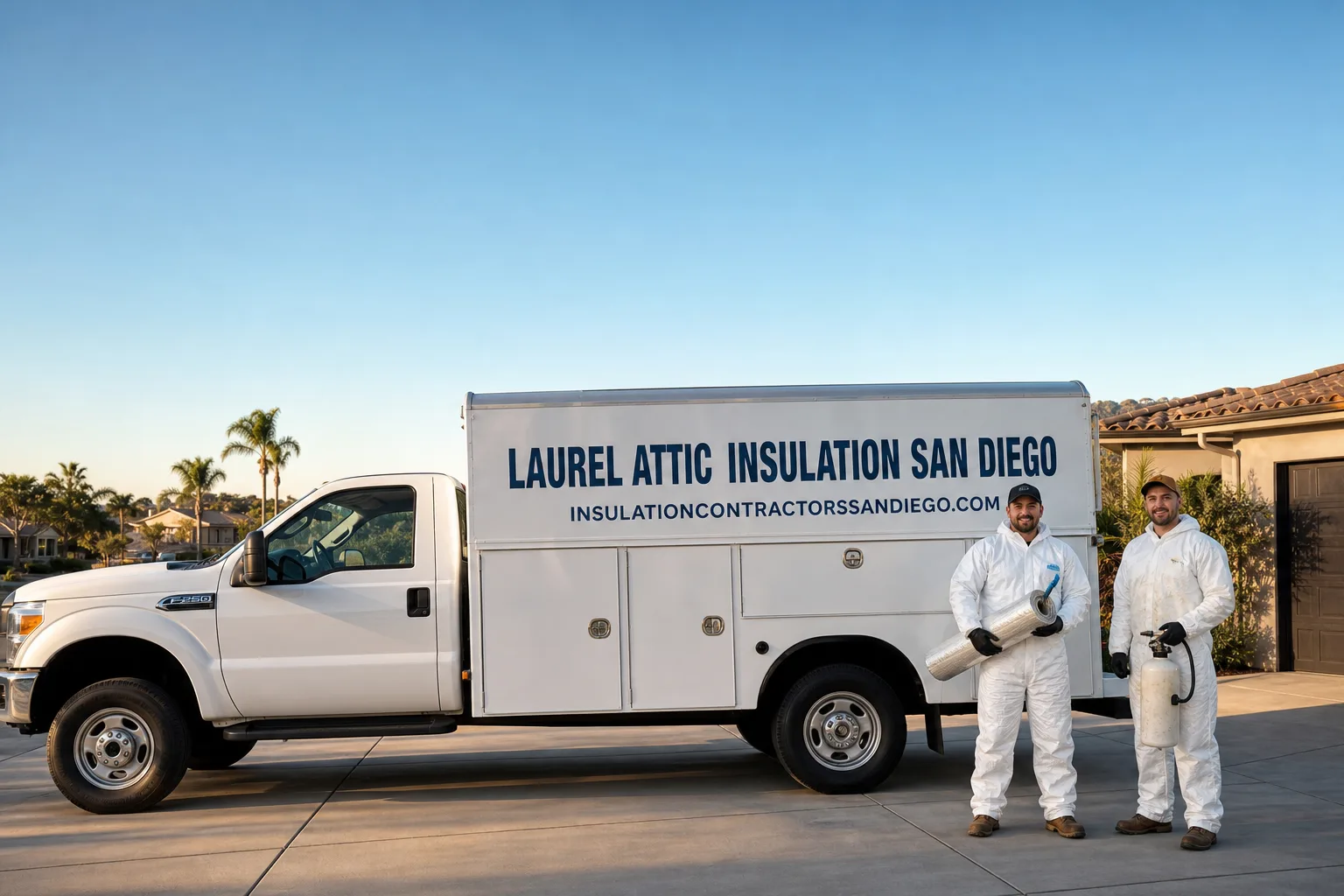
How Much Does Blown-In Insulation Cost in San Diego?
Blown-in insulation in San Diego typically costs $1,450 to $3,600 for a standard 1,500-square-foot attic, with most homeowners paying around $2,400 for R-38 fiberglass or cellulose. Smaller attics or partial top-ups can run as low as $800, while larger homes needing air sealing plus full removal and reinstall can reach $6,500 or more. The two biggest variables are square footage and the R-value your home needs, followed closely by whether we’re topping up existing insulation or starting from scratch.
Let’s get specific. We price hundreds of blown-in insulation jobs across San Diego every year, from Clairemont to Chula Vista to Rancho Bernardo, and we write the number down before we touch a staple. Here’s exactly what goes into the cost, what you’ll pay by material, and where homeowners leave money on the table.
Key Takeaways: Blown-In Insulation Pricing in San Diego
- Typical attic job: $1,450 to $3,600 for 1,500 sq ft at R-38
- Per square foot installed: $1.10 to $2.40 depending on material and depth
- Fiberglass blown-in: $1.10 to $1.70 per sq ft installed
- Cellulose blown-in: $1.40 to $2.10 per sq ft installed
- Most common add-on: Air sealing ($300 to $700) before blowing in new material
- Removal of old insulation: $1.50 to $3.00 per sq ft if needed
- Free estimates: Always. Call (619) 793-3676 and we’ll give you a written price.
Blown-In Insulation Cost Breakdown (2026)
Here’s a line-by-line look at what you’ll see on a typical San Diego blown-in insulation quote. These numbers reflect actual 2026 pricing in our market, not national averages. San Diego sits in Climate Zone 3 (mostly), which means the California Building Code calls for R-30 to R-38 in attics depending on your exact location and build year. East County and inland areas like El Cajon and Santee push toward the higher end because of summer heat; coastal spots like Ocean Beach and Pacific Beach can often do fine at R-30.
| Line Item | Cost Range | Notes |
|---|---|---|
| Blown-in fiberglass (R-38, 1,500 sq ft) | $1,650 – $2,550 | Most common choice for standard attics |
| Blown-in cellulose (R-38, 1,500 sq ft) | $2,100 – $3,150 | Better air-sealing performance, slightly heavier |
| Top-up over existing insulation (R-19 to R-38) | $800 – $1,400 | If existing material is dry and pest-free |
| Air sealing (can lights, top plates, penetrations) | $300 – $700 | Strongly recommended before new insulation |
| Old insulation removal | $1.50 – $3.00 per sq ft | Required for rodent damage, water damage, or heavy dust |
| Attic access improvement (larger hatch, walkway) | $200 – $500 | Often needed when converting from batt to blown-in |
| Whole-home energy audit add-on | $150 – $400 | Identifies leakage points beyond the attic |
That table reflects what we write on quotes in 2026. One thing worth saying plainly: if a San Diego contractor quotes you under $1,000 for a full 1,500-square-foot attic at R-38, ask what R-value they’re actually installing. We’ve fixed too many jobs where someone blew six inches and called it done. You’ll feel the difference in your July electric bill.
What Affects Blown-In Insulation Pricing in San Diego
Price swings on blown-in insulation come down to six factors. Here’s how each one plays out in San Diego specifically.
- Square footage and attic geometry. A 900-square-foot Mission Valley condo attic costs less than a 2,800-square-foot Poway single story. But geometry matters too: low-pitch roofs, cramped knee walls, and attics with lots of cross-bracing slow the crew down. Steep access ladders in older Normal Heights and North Park homes add labor time.
- Target R-value. R-value is the number that measures how well insulation slows heat from moving through your ceiling. Higher R-value means more material, more depth, more cost. The California Building Code baseline for San Diego attics is R-30, but we recommend R-38 for most homes because the incremental cost is small and the summer comfort gain is real. Going from R-30 to R-38 typically adds $250 to $400 on an average attic.
- Material choice. Fiberglass runs cheaper than cellulose in most cases. Cellulose performs better in windy attics and fills odd cavities more effectively because it’s denser. Both are solid options; the price difference is driven by material cost and install density, not marketing markup.
- Condition of existing insulation. If your current insulation is dry, uncompressed, and pest-free, we can blow new material right over it. If it’s damp from a roof leak, full of rodent droppings, or packed down to half its original R-value, it has to come out first. In coastal areas like La Jolla and Del Mar, we see more moisture-related degradation from marine layer fog. Inland, it’s more often rodent damage from roof rats, which are a real problem in neighborhoods like Scripps Ranch and Carmel Valley.
- Air sealing work. Blowing insulation over an unsealed attic is like putting on a warm jacket and leaving the zipper open. Air moves through can-light housings, plumbing penetrations, and top plates, bypassing whatever insulation you install. We include a basic air-sealing recommendation on nearly every job. It adds cost upfront but pays back the fastest, especially in older homes built before 2000.
- Access and prep work. If your attic hatch is 22 inches square and the access is in a bedroom closet, we may recommend enlarging it or installing a drop-down ladder. Some San Diego homes from the 1950s and 1960s in neighborhoods like Clairemont and Allied Gardens were built with tiny scuttle holes that make proper installation nearly impossible. Fixing access is a one-time cost that makes future service simpler.
Blown-In Fiberglass vs. Cellulose: Cost and Performance in San Diego
San Diego’s climate is mild enough that both materials work well, but the choice affects your upfront cost and long-term utility bill. Here’s the honest breakdown.
Blown-In Fiberglass
Cost: $1.10 to $1.70 per square foot installed at R-38.
Best for: Standard attic retrofits where existing insulation is in decent shape.
San Diego note: Fiberglass is lighter than cellulose, which matters if you have older ceiling drywall. It also doesn’t settle as much over time. The downside is that it performs slightly worse in windy conditions and doesn’t block air movement as well as cellulose.
Blown-In Cellulose
Cost: $1.40 to $2.10 per square foot installed at R-38.
Best for: Older homes, attics with lots of odd cavities, and situations where air sealing is a priority.
San Diego note: Cellulose is denser and does a better job slowing air infiltration. In East County areas like Lakeside and Alpine where Santa Ana winds whip through attics, cellulose often outperforms fiberglass at the same R-value. The tradeoff is weight and a slightly higher material cost.
We install both, and we’ll match the material to your attic, not to whatever happens to be loaded on the truck that morning. Our material lineup includes Owens Corning, Johns Manville, Knauf, CertainTeed, and GreenFiber, so we’re not tied to a single brand’s pricing or availability.
When You Need Insulation Removal Before Blowing In New Material
Removal adds $1.50 to $3.00 per square foot to the job. It’s not always necessary, but there are times it’s the only responsible move.
- Rodent infestation. Roof rats are a genuine issue in many San Diego neighborhoods. Their droppings and urine soak into insulation, and no amount of new material on top fixes that. We remove, sanitize, then blow in fresh insulation.
- Water damage. A roof leak or AC condensate line failure can soak insulation and compress it. Wet insulation loses most of its R-value and can grow mold. In coastal neighborhoods, we see more of this than people expect because a slow drip can go unnoticed for a year.
- Old, compressed insulation. Some San Diego homes still have original 1960s or 1970s insulation that’s settled to a third of its original thickness. Blowing over it won’t get you back to R-38.
If removal is needed, we include it as a separate line item on the written quote so you see exactly what you’re paying for. No one discovers a surprise removal fee at the door.
How to Save on Blown-In Insulation in San Diego
Here are the legitimate ways to reduce your out-of-pocket cost without cutting corners on performance.
- Get a written quote from a company that doesn’t charge for estimates. Sounds obvious, but some San Diego insulation contractors charge $50 to $100 just to look at your attic. We don’t. Call (619) 793-3676 and we’ll give you a written price before any work starts.
- Check for utility rebates. SDG&E has run insulation rebate programs in various years, and the federal 25C tax credit still applies to qualifying insulation work in 2026. We can point you to current programs but you’ll want to verify eligibility with the program administrator. Savings typically range from $100 to $400 on a standard attic.
- Bundle air sealing with insulation. Doing both at once costs less than doing them separately because the crew is already in the attic with the equipment set up. Most combined jobs run $1,800 to $4,200 total, which is about $200 to $400 below what you’d pay doing them on separate visits.
- Top up instead of full replacement when possible. If your existing insulation is dry, clean, and just under-performing, adding a top-up layer gets you to R-38 for $800 to $1,400 instead of $2,000 to $3,600 for full removal and replacement.
- Do the prep work yourself if it’s simple. Moving stored items out of the attic access area, trimming back overgrown vegetation near the attic hatch, and making sure the access path is clear can shave an hour off a job. That’s real money.
- Ask about seasonal scheduling. Late fall and winter are slower months for insulation work in San Diego. Some companies offer modest discounts for flexible scheduling during those periods. We’ll tell you the best available pricing when you call.
San Diego Climate Zone and Building Code Basics
San Diego County spans Climate Zones 3, 6, and 7 under California’s Title 24 energy code, but the majority of the city of San Diego falls in Zone 3, with some inland areas of East County classified as Zone 6 or 7. That’s why the code baseline is R-30 in most of the county and R-38 in hotter inland pockets.
What this means in practice: a contractor who quotes you R-30 for a home in Santee or El Cajon is meeting the letter of a generic recommendation but ignoring how those areas actually perform in August. We quote R-38 as our standard for all of San Diego County, with deeper options available if you want to go further. The cost difference between R-30 and R-38 on a 1,500-square-foot attic is usually $250 to $400, which is a small premium for a material that lasts decades.
Why Blown-In Insulation Works Well in San Diego Homes
San Diego’s reputation for perfect weather hides a real comfort problem: many homes built before 2000 have attics with R-19 or less, and that thin barrier lets heat pour down through ceilings during summer afternoons. Blown-in insulation works especially well in San Diego blown-in insulation retrofits because it fills irregular cavities, reaches into corners, and creates a continuous thermal blanket that batts can’t match. For homes in our service area, it’s usually the highest-value energy upgrade you can make.
In neighborhoods like University Heights and Normal Heights, where homes date to the 1930s through 1950s, attics often have no insulation at all or a thin layer of degraded original material. Those are cases where the before-and-after difference is dramatic. We’ve measured 25 to 35 degree attic temperature reductions after proper R-38 installation, which translates directly to how hard your AC works in August.
Air Sealing: The Hidden Half of the Job
Blowing insulation into an attic without air sealing first is a common mistake. Warm air from your living space rises into the attic through gaps around light fixtures, plumbing stacks, electrical penetrations, and interior wall top plates. That air carries heat and moisture with it, and it bypasses whatever insulation sits on the attic floor.
Air sealing costs $300 to $700 for a typical 1,500-square-foot San Diego home, and it involves sealing those leakage points with foam or caulk before insulation goes in. The energy savings from air sealing often match or exceed the savings from the insulation itself. When you combine the two, most homeowners see a 15 to 30 percent reduction in heating and cooling costs, with the bulk of that showing up in July through September bills.
FAQs – Blown-In Insulation Cost
How much does blown-in insulation cost per square foot in San Diego?
Blown-in insulation in San Diego costs $1.10 to $2.40 per square foot installed, with fiberglass on the lower end and cellulose on the higher end. That price includes labor, materials, and equipment setup. A 1,000-square-foot attic at R-38 runs roughly $1,150 to $2,200. Call (619) 793-3676 for a written quote on your exact square footage, estimates are free.
Is it cheaper to install blown-in insulation myself?
Renting a blower machine from a home improvement store costs $70 to $150 per day, and loose-fill fiberglass runs $35 to $55 per bag, with a 1,000-square-foot attic needing 20 to 30 bags. That puts DIY material costs around $800 to $1,500, but you’re doing the work without air sealing, without a proper depth gauge, and without the safety equipment to handle abrasive fiberglass dust. Most people who DIY it call us within two years to fix uneven coverage. Professional installation with a written guarantee typically costs only $300 to $700 more than DIY materials.
Can you blow insulation over existing insulation?
Yes, if the existing insulation is dry, clean, and structurally intact. A top-up over R-19 or R-13 to reach R-38 typically costs $800 to $1,400 for a 1,500-square-foot attic. If the old material is wet, pest-damaged, or compressed below half its original depth, removal is necessary and adds $1.50 to $3.00 per square foot. We’ll tell you which camp you’re in before we quote anything.
How long does blown-in insulation last in San Diego?
Blown-in fiberglass and cellulose both last 20 to 30 years under normal conditions, though cellulose can settle slightly more over the first year. San Diego’s dry climate and mild temperatures are actually favorable for insulation longevity compared to humid or extreme-cold regions. The bigger threats to lifespan here are roof rats and roof leaks. We back every installation with our 365-Day Done Right Promise: if anything isn’t right within a year, we fix it at no charge.
How much can blown-in insulation reduce my energy bill in San Diego?
Most San Diego homeowners see a 15 to 30 percent reduction in cooling and heating costs after upgrading from R-19 or less to R-38, with the biggest savings in July through October. On a $250 average summer electric bill, that’s $37 to $75 per month during peak cooling season. Combined with air sealing, some homes with poor existing insulation see savings up to 40 percent. The payback period for a typical $2,400 attic job is usually 3 to 6 years, sooner if SDG&E rates continue rising.
Do I need a permit for blown-in insulation in San Diego?
No permit is required for adding or replacing attic insulation in residential buildings in San Diego. However, if your project includes structural changes like attic access enlargement or ventilation modifications, a permit may apply. We handle the scope assessment and tell you upfront if any permitting would be needed. For standard blow-in jobs, you’re clear to proceed the same week.
The Laurel Attic Insulation San Diego Approach to Pricing
We built our pricing process around one idea: you should know the exact number before any work starts, and that number shouldn’t change when the crew shows up. That’s what we call the Relay Visibility Guarantee, and it’s part of every job we do.
When you call (619) 793-3676, here’s what happens. We answer the phone live, any hour, any day. We schedule a time that works for you and send a background-checked, uniformed technician to your home with a live, trackable arrival time. The technician assesses your attic, discusses your goals, and writes a line-item price on the spot. You approve it or you don’t. If you do, the work gets scheduled and you get photo proof of the completed job before we leave.
We also give you a written 365-Day Done Right Promise on every installation: if it’s not done right within a year, we make it right. And if a repair we performed fails, the second visit is free. That’s not a slogan on a website; it’s in the documentation you get with your invoice.
Laurel stays green all year, so should your home’s comfort. That’s the idea behind the name. We’re part of the Relay Home Co. family, and we’ve been doing this since 2003. Our material selection spans eight industry-trusted brands: Owens Corning, Johns Manville, Knauf, Rockwool, CertainTeed, Icynene, Demilec, and GreenFiber. The right material gets matched to your attic, your budget, and your comfort goals.
Get Your Written Blown-In Insulation Quote
If you’re ready to know exactly what blown-in insulation will cost for your San Diego home, call (619) 793-3676. We’ll give you a free, written estimate with line-item pricing. You’ll get a live arrival time, a technician who shows up on time, and a price that doesn’t change when the work starts.
This is insulation done the way it should be: clear, specific, and in writing. Call today, or explore more about Laurel Attic Insulation San Diego to see how we work.
Written by Chase Whitaker, Owner at Laurel Attic Insulation San Diego, serving San Diego since 2003.
Pricing reflects the San Diego market as of 2026. Laurel Attic Insulation San Diego offers free estimates – call (619) 793-3676.
What Our Customers Say
"Spray foam in the crawl space. Floors feel warmer."
- Joanna S."Utility bill dropped the next month. Our summer electric bill was lower by a visible amount."
- Gary J."Booked a quote online and got a text when the crew was on its way. Blown-in insulation went in quickly and they sent before and after photos."
- Ron D.