
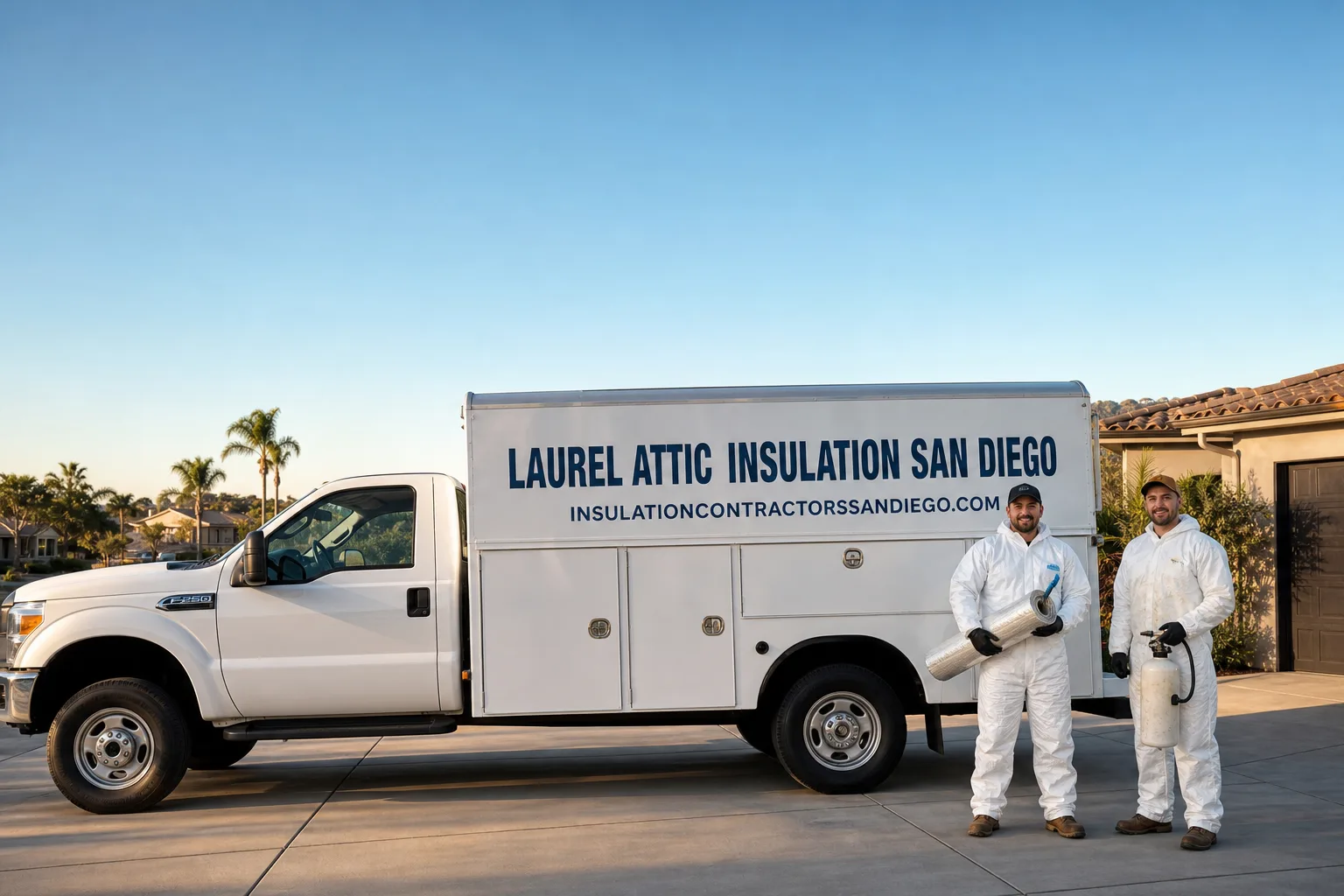
Fast, Reliable Attic Insulation Across National City
Most attic insulation jobs in National City run between $900 and $3,400, depending on square footage, the R-value your home needs, and whether we’re topping up existing insulation or starting from scratch. Our crews serve National City daily, usually arriving within 48 hours of your call. We know these streets, these attics, and the way a 1940s bungalow off East Plaza Boulevard behaves differently than a 1960s apartment building near the 805. Call (619) 793-3676 for an exact written price before any work starts.
National City’s older housing stock wasn’t built for the kind of heat that sits over the inland neighborhoods between I-5 and I-805. Most homes from the 1920s through the 1950s went up with zero attic insulation, and the ones that got some have batts that lost their effectiveness decades ago. We’re the Attic Insulation team that treats every job as a surgical fix for the specific attic we’re standing in, not a one-size-fits-all blow-and-go.
Why Laurel Attic Insulation San Diego Is National City’s Preferred Attic Insulation Company
Chase Whitaker leads our San Diego team, and the standard he set is simple: a written price before work starts, background-checked technicians in uniform, live arrival tracking, and photo proof of every job. National City homeowners tell us they’re tired of contractors who quote one number on the phone and another at the door. That doesn’t happen here. The price we write is the price you pay, and the guarantee we write with it covers workmanship for 365 days.
Our response time to National City is tight because we dispatch locally, not from some far-off hub. Scheduling is coordinated from our San Diego office, but crews roll into National City neighborhoods like Kimball, Old Town, and Paradise Hills on a daily basis. When you call, a live person answers, 24/7. You get a live arrival time, not a four-hour window. You see your technician coming on a map, like a rideshare. And after the job, you get before-and-after photos and a digital invoice you can pay from your phone.
The 365-Day Done Right Promise is exactly what it sounds like: if the work isn’t right, we make it right, in writing, on every single job. If a repair fails within that year, the second visit is free. No charge, no argument. That’s the Relay Visibility Guarantee, and it’s standard on every attic we touch in National City.
Attic Ventilation in National City
Attic Ventilation in National City is not optional, and here’s why: the marine layer rolls in most mornings, saturates the air with moisture, and then burns off by noon, leaving a hot, dry attic that bakes whatever insulation is up there. Without proper airflow, that moisture condenses on uninsulated framing, stains drywall, and creates the exact conditions mold loves. Homes in National City’s older neighborhoods, especially those with original asphalt-saturated felt paper under stucco, trap this moisture cycle worse than anywhere else in the South Bay.
What Ventilation Work Actually Involves
We inspect ridge vents, gable vents, soffit vents, and any existing baffles. In most National City attics from the 1920s through the 1950s, we find vent screens corroded by salt air from San Diego Bay, which lets squirrels and birds in while blocking the airflow the attic desperately needs. We replace corroded vents, clear blocked soffits, and install baffles where insulation would otherwise choke off the air path. A typical ventilation correction in National City runs $250 to $700, often done alongside insulation in the same visit.
When a Homeowner Needs It Now
If you see rust-colored stains on ceilings, smell musty air upstairs, or notice the second floor stays hot well after sunset, your attic ventilation is failing. Older low-slope roofs common in National City trap heat under minimal clearance, and sagging insulation makes airflow worse. We fix this before we blow in new insulation, because insulation without ventilation just seals the problem in.
Radiant Barrier in National City
Radiant Barrier in National City is the single most underrated fix for homes that feel like ovens by 3 p.m. in July. It’s a reflective material, usually foil-faced, installed under the roof deck to bounce radiant heat back out instead of letting it soak into the attic. For National City’s inland climate, where daytime heat is more extreme than coastal San Diego but the marine layer still complicates moisture management, a radiant barrier paired with proper ventilation works better than adding insulation alone.
How We Install It in Low-Clearance Attics
Many National City attics have tight clearances that make batt insulation difficult to install well. Radiant barrier is actually ideal for these spaces. We staple it to the underside of the roof rafters, which requires no floor access and doesn’t trap moisture. In a 1940s bungalow with uninsulated 2×4 walls, adding radiant barrier plus R-38 attic insulation often drops second-floor temperatures by 10-12°F. Expect to pay $1,100 to $2,800 for a full radiant barrier installation in a National City attic, depending on roof area and accessibility.
When It Makes Sense Over More Insulation
If your attic already has some insulation but the house still cooks in the afternoon, radiant barrier attacks the problem at the source: heat hitting the roof. For flat or low-slope roofs common in National City’s older builds, the barrier reduces what the insulation has to fight. It’s not a replacement for insulation; it’s a force multiplier.
Trusted Brands We Service in National City
We install materials from eight industry-trusted manufacturers, and we match the brand to the job instead of whatever’s left on the truck. For National City’s low-clearance, moisture-sensitive attics, we often recommend GreenFiber blown-in cellulose for its dense-pack air-sealing qualities, CertainTeed fiberglass batts for cost-effective R-value in accessible attics, and Demilec or Icynene spray foam where air-sealing is the priority. Because we stock National City jobs from our local supply chain, we can typically start within two days of your estimate and finish most attics in a single day.
Common Attic Insulation Problems We See in National City Homes
- Salt-air rust on attic hardware and vent screens. San Diego Bay’s salt air corrodes fasteners, vent screens, and gable louvers years faster than inland locations. Corroded vents block airflow and invite wildlife entry, which destroys insulation and creates sanitation hazards.
- Marine-layer moisture condensing on framing. The morning marine layer that rolls over National City deposits moisture on uninsulated attic framing, especially where original asphalt-saturated felt paper is breaking down under stucco. This shows up as ceiling stains and musty air, and it must be addressed before new insulation goes in.
- Compressed and sagging batts in low-clearance attics. Original fiberglass batts from the 1950s and 1960s sag under their own weight in low-slope roofs, losing R-value and leaving bare spots. Storage boards laid over batts compress them to nearly zero effectiveness. This is the most common issue we find between I-5 and I-805.
- No air-sealing around top plates and penetrations. Hot air rises from living spaces into attics through gaps around ceiling fixtures, top plates, and plumbing penetrations. In old National City bungalows, these gaps can total a square foot or more, which means your air-conditioned air is paying rent in the attic. Air-sealing before insulation is the only way to get full value from any material.
Pricing for Attic Insulation in National City, CA
A straightforward attic insulation top-up in a small National City bungalow, blowing GreenFiber cellulose to R-38 over existing batts, typically runs $900 to $1,600. A full replacement, including removal of old, contaminated insulation and disposal, runs $2,400 to $3,400 for a standard 1,000-square-foot attic. Adding radiant barrier runs $1,100 to $2,800. Ventilation corrections add $250 to $700. What moves the needle? Access: attics with 24 inches of headroom are faster than crawl-through attic spaces with 30-inch clearance. Waste disposal, if old insulation is contaminated. And the R-value you choose: R-38 is our minimum for National City’s inland heat, R-49 is better, and R-60 is the gold standard for second-floor comfort. Every estimate is free, and the written price you get is the price you pay.
We Also Serve Cities Near National City
Our crews cover the South Bay and beyond. If you’re in Bonita, Coronado, Lemon Grove, or nearby San Diego neighborhoods, the same National City team can reach you quickly, with the same written price and 365-day guarantee. Call (619) 793-3676 and we’ll confirm the next available time for your area.
Serving National City, CA - Our Local Coverage Area
We’re based in the National City area and know this community well. Use the map below to see our service coverage - if you’re nearby, we can almost certainly help.
FAQs About Attic Insulation in National City
National City’s inland location gets hotter daytime temperatures than the beach neighborhoods, but still receives the marine layer most mornings. That combination of heat and moisture means a poorly ventilated attic will trap moisture, grow mold, and cook the insulation from above. We always assess and correct ventilation before blowing in new material here. Call (619) 793-3676 for a free attic evaluation.
Salt air corrodes the metal components around your attic: vent screens, fasteners, gable louvers, and any exposed duct hangers. It also promotes rust on recessed light housings that leak air into the attic. In National City’s older homes, this means insulation often gets damaged by wildlife entering through corroded vents. We replace the corroded components with coated or stainless hardware before insulating.
Yes, and the numbers are consistent. Last summer, our crew worked on a 1940s bungalow off East Plaza Boulevard near Kimball Park, where the attic had just a single layer of degraded fiberglass batts compressed under storage boards. After air-sealing the top plates and blowing in GreenFiber cellulose to R-38, the homeowner reported a 12°F drop in second-floor bedroom temperature by the following evening, even with the marine layer burning off by noon. Attic insulation is the highest-ROI retrofit in National City because closed-wall drilling is costlier and less effective than attic work.
For National City’s tight attics, blown-in cellulose performs best because it settles around framing, fills irregular cavities, and doesn’t require standing room to install. GreenFiber cellulose is our go-to for low-clearance attics between the 1920s and 1950s, because it air-seals as it fills. In attics with adequate clearance, CertainTeed fiberglass batts are a cost-effective alternative. We’ll tell you what’s actually best for your specific attic, not what’s easiest for us.
Yes. Raised foundations in National City’s pre-1960s homes allow warm, moist air to rise from the crawlspace through wall cavities into the attic, which means air-sealing the top plates and any plumbing or electrical penetrations is essential before insulation goes in. Newer slab-on-grade homes still need air-sealing, but the leakage paths are fewer. We inspect the whole envelope, from crawlspace to attic, before recommending a plan. Call (619) 793-3676 for a free assessment.
Written by Chase Whitaker, Owner at Laurel Attic Insulation San Diego, serving National City since 2003.