
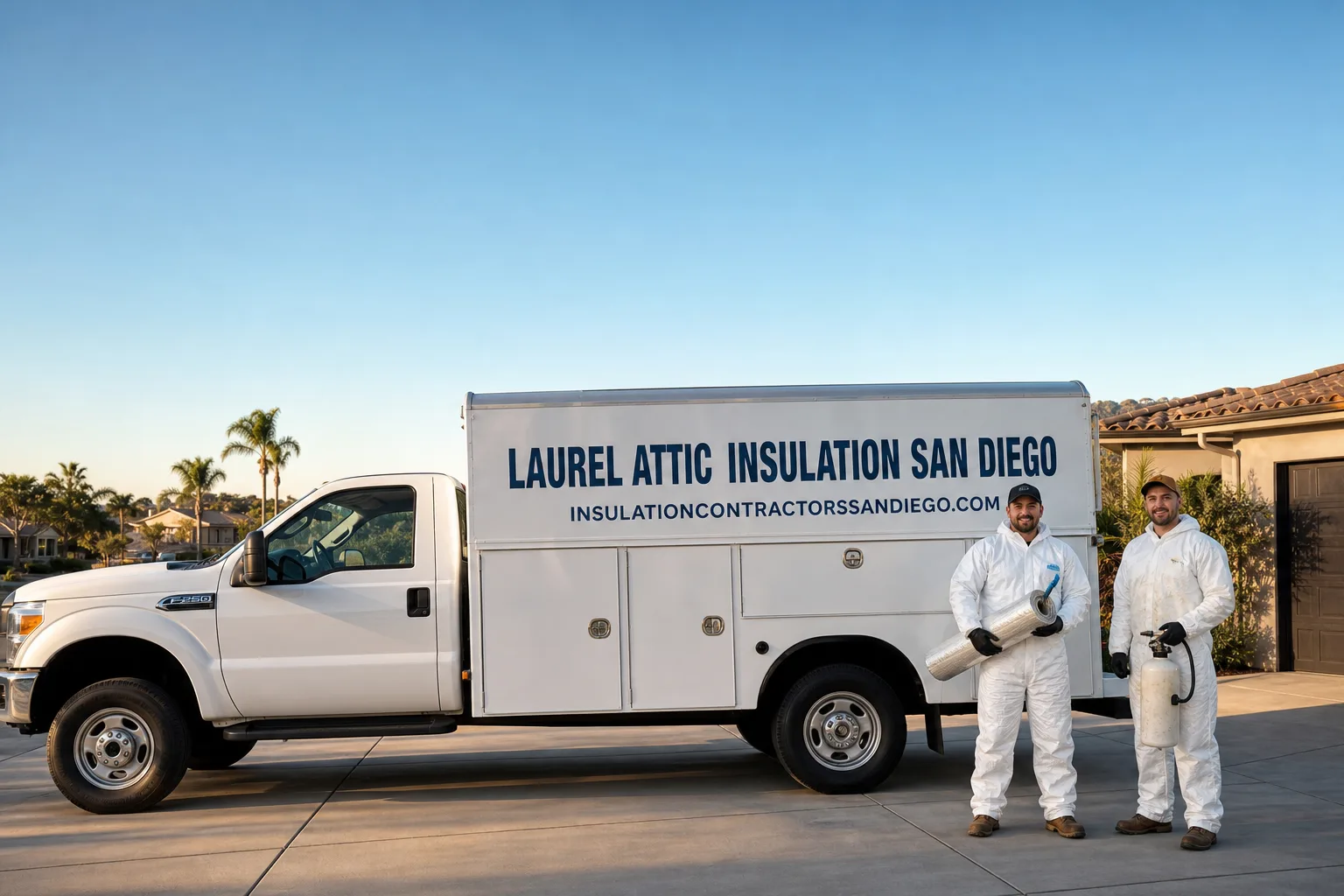
Fast, Reliable Attic Insulation Across San Diego
If you’re searching for attic insulation in San Diego, the short answer is this: most whole-attic insulation jobs run $900 to $2,400 depending on square footage and the R-value you need, and we can usually get a crew to your door within one to two business days. San Diego’s split personality when it comes to climate means the right insulation strategy changes block by block. A 1960s tract home in Clairemont needs something very different from a 2005 build in 4S Ranch. We know that because we’re San Diego based, not a franchise dispatch center. Call (619) 793-3676 and a live person picks up, day or night.
We’re Laurel Attic Insulation, part of the Relay Home Co. family, and our Attic Insulation crew works exclusively in San Diego County. What that means for you: we know the difference between the marine layer in Ocean Beach and the dry heat in El Cajon, and we size your insulation accordingly.
Why Laurel Attic Insulation San Diego Is San Diego’s Preferred Attic Insulation Company
Most insulation contractors make you wait in a four-hour window and then quote a number that changes when they step out of the attic. We don’t operate that way. Every job starts with a written price delivered before work begins. You get live technician tracking, same as you’d expect from a rideshare app. That’s the Relay Visibility Guarantee, and it’s in writing on every single job.
Chase Whitaker leads our San Diego operation, and he’s built the crew around a simple rule: treat the homeowner’s time like it’s valuable. Our technicians are background-checked, uniformed, and trained on materials from Owens Corning, Rockwool, Icynene, and Demilec. They match the material to your attic, not to whatever is sitting on the truck. If the work isn’t right after 365 days, we come back and make it right. That’s the Done Right Promise, and it’s also in writing.
Attic Ventilation in San Diego
Attic ventilation in San Diego matters more than in most climates, particularly in coastal zones where damp marine air gets pulled into attics at night. A properly vented attic moves air through soffit vents, up and out ridge or gable vents. When that path is blocked, heat and moisture sit up there. That’s how you get mold on the underside of roof sheathing in Point Loma, or shingles that curl and cook in inland summer heat. Ventilation work in San Diego typically runs $350 to $900 for adding baffles, repairing soffit vents, or correcting a bad fan installation.
Soffit Baffles and Airflow Correction
Older tract homes in neighborhoods like Clairemont and Allied Gardens were often built with minimal eave venting, and a previous owner may have blown insulation right over the soffit vents. When that happens, the attic chokes. We install baffles to hold insulation back, then verify airflow with a simple smoke test. It sounds minor. It isn’t. This single fix can drop attic temps by 20°F in a La Mesa summer.
Attic Fan Wiring and Replacement
A fan wired to run 24/7 in a coastal attic pulls moist ocean air across your insulation every night. We see this constantly in San Diego homes built within a mile of the coast. The fix is either a humidistat that shuts the fan off above a set moisture threshold, or a full replacement with a properly sized unit on a thermostat. Fan replacement runs $280 to $650, and we’ll show you before-and-after photos of the wiring so you know what you paid for.
Radiant Barrier in San Diego
Radiant barrier in San Diego is a heat rejection tool, and it works best in attics that actually get hot, which means inland zip codes more than beach bungalows. A radiant barrier is a reflective foil-similar to what you’d find with a San Diego Reflectix service-stapled to the underside of roof rafters. It bounces radiant heat back out before it can radiate down into your insulation and your living space. Installed correctly, it can cut attic temps by 20 to 30 degrees on a 95°F day in El Cajon or Escondido. Radiant barrier installation typically runs $1.50 to $3.00 per square foot in San Diego, depending on attic access and rafter spacing.
Correct Foil Orientation
One of the most common failures we fix is radiant barrier that was stapled shiny-side down against the roof deck. That traps heat between the foil and the sheathing, and after two seasons of inland summer heat, the foil delaminates and stops working entirely. The shiny side has to face the attic air space. We see it wrong about a third of the time we’re called out for a radiant barrier quote.
Coastal vs. Inland Radiant Barrier Decisions
If you live in La Jolla or Ocean Beach within sight of the water, a radiant barrier may not be your best first move. Coastal attics rarely get hot enough to justify the cost. What they do get is damp, and moisture control matters more. Inland, though, a radiant barrier paired with blown-in insulation often cuts upstairs AC runtime noticeably. We’ll tell you honestly which side of the decision you’re on. That’s the whole job.
Trusted Brands We Service in San Diego
We stock and install materials from Owens Corning, Johns Manville, Knauf, Rockwool, CertainTeed, Icynene, Demilec, and GreenFiber. That matters because not every insulation problem has the same answer. A 1970s Allied Gardens attic with settled fiberglass batts needs something different from a new build in Otay Ranch that just needs a top-up to meet Title 24. We carry what San Diego homes actually need and we don’t push one brand on every house. If a customer specifically wants Icynene spray foam for an attic conversion or Demilec for a knee wall, it’s on the schedule and ready to go.
Common Attic Insulation Problems We See in San Diego Homes
- Settled and degraded fiberglass batts in pre-1980 tract homes. We pulled into a Clairemont tract home where the attic had only settled 3-inch fiberglass batts from 1962. Our crew vacuumed the old batts, air-sealed the top plates, and blew in Owens Corning AttiCat to R-38, cutting the homeowner’s upstairs AC runtime by a third the first August week.
- Radiant barrier foil oriented incorrectly. Shiny-side-down installation against the roof deck is a recurring failure in San Diego attics that see real summer heat. Two seasons in, the barrier stops reflecting and starts trapping heat. We fix it by pulling the old foil and stapling a new barrier with the reflective face into the attic air space.
- Attic ventilation fans pulling in coastal moisture. In neighborhoods like Pacific Beach and Ocean Beach, fans wired to constant-on draw damp marine air through the attic all night. That soaks the insulation and invites mold. The answer is usually a humidistat, a rewiring, or replacing the fan with a unit sized for the actual attic volume.
- Blown-in insulation packed into soffit vents. Many older San Diego homes lack eave baffles, so when blown-in insulation gets added, it lands directly in the soffit vents and blocks airflow. The attic stops ventilating, shingle temps rise, and AC bills climb. Installing baffles before or during the blow-in solves it permanently.
Pricing for Attic Insulation in San Diego, CA
An attic insulation top-up in San Diego typically runs $500 to $1,200 for a standard 1,200-square-foot attic. A full replacement with air sealing and new blown-in insulation runs $1,500 to $2,400 in most homes. Batt insulation for a 1950s or 1960s tract house in Clairemont or Allied Gardens falls in the $1,200 to $1,800 range. Radiant barrier adds $1.50 to $3.00 per square foot. Ventilation corrections run $350 to $900. What moves the number: attic access, existing insulation condition, whether air sealing is needed, and the target R-value for your Title 24 compliance zone. You’ll get a written price before any work starts and a free second visit if the repair fails. Call (619) 793-3676 for an exact quote.
We Also Serve Cities Near San Diego
Our crews dispatch from San Diego and regularly run jobs in San Diego plus the surrounding communities. If you’re in Coronado, National City, Lemon Grove, or Bonita, you’re in our service area and you get the same live tracking, written pricing, and 365-Day Done Right Promise. Same crew standards, same materials, same day response when we can swing it.
Serving San Diego, CA - Our Local Coverage Area
We’re based in the San Diego area and know this community well. Use the map below to see our service coverage - if you’re nearby, we can almost certainly help.
FAQs About Attic Insulation in San Diego
In most cases, no. San Diego’s coastal climate doesn’t create the strong vapor drive you’d see in a cold climate, and adding a vapor barrier on the wrong side can trap moisture inside your ceiling assembly and cause mold. What Ocean Beach and Point Loma homes usually need instead is better attic ventilation and air sealing at the top plates. We’ll assess the attic moisture level before recommending anything. If you’re in Ocean Beach and your insulation has been damp, it may be time to consider Insulation Removal - San Diego. Call (619) 793-3676 and we’ll do a moisture check as part of the free estimate.
For San Diego’s climate zone, a 1970s tract home in Allied Gardens will need an R-38 attic insulation level to meet current Title 24 requirements for retrofit work. Most 1970s homes here have settled R-11 to R-19 at best, so a top-up to R-38 is usually a straightforward blown-in job. We’ll measure what’s up there and give you a written quote to bring it to compliance. Call (619) 793-3676 and we’ll check your attic’s current R-value during the estimate.
You can, but it’s often not the smartest spend in a coastal La Jolla home. Radiant barriers deliver the biggest cooling savings in attics that get genuinely hot, which is an inland condition. In La Jolla, the marine layer suppresses attic heat, so you may get better return from air sealing and bumping your insulation from R-19 to R-38. We’ll tell you straight what the payback looks like for your specific house. Estimates are free at (619) 793-3676.
Damp attic insulation in San Diego is almost always a ventilation problem, not a temperature problem. Coastal fog and winter rain bring high relative humidity, and if your attic can’t move that moist air out through the soffit and ridge vents, it condenses on the insulation and roof sheathing. We routinely find blocked soffit vents or a vent fan that’s wired to run constantly in homes from Ocean Beach to Clairemont. The fix starts with diagnosing airflow. Call (619) 793-3676 and we’ll inspect the ventilation during a free attic assessment.
Blown-in fiberglass and cellulose degrade slowly with heat and moisture cycling, but the bigger issue in El Cajon is settling. If your blown-in insulation has compacted from its original depth, the R-value drops. We measure depth and density with an R-value inspection, and we pull a small sample to check for moisture damage. If it’s underperforming, a top-up or full replacement brings it back to R-38. Call (619) 793-3676 to schedule an inspection and get a written quote for whatever the attic actually needs.
Written by Chase Whitaker, Owner at Laurel Attic Insulation San Diego, serving San Diego since 2003.