
Last updated October 17, 2026
The Complete Guide to Insulation in San Diego
San Diego averages only 23 heating days per year, yet EnergyStar data shows Southern California homes waste more cooling energy than homes in Phoenix. The reason is simple: builders bet on our mild weather doing the work, so they skimped on insulation. That bet fails every summer when your attic hits 140°F and your AC runs nonstop. This guide covers how insulation actually works in San Diego’s specific climate, what it costs, what California Title 24 requires, and how to tell whether your home is under-insulated before you spend a dime on upgrades.
Quick Answer
Insulation in San Diego is a year-round thermal and moisture management system, not a cold-weather fix. Most San Diego homes built before 2000 are under-insulated by current standards, which means higher cooling bills in summer and damp, chilly rooms in winter. A properly insulated attic tuned to your microclimate typically costs $900 – $2,400 and pays for itself through lower SDG&E bills within 3 to 6 years.
Table of Contents
- San Diego’s Three Microclimates and What They Mean for Insulation
- Why Your Attic Hits 150°F When It’s 75°F Outside
- R-Value Explained: Title 24 Minimums vs. What San Diego Actually Needs
- Insulation Materials Compared: Real Prices for San Diego Homes
- How to Read Your Utility Bill as a Diagnostic Tool
- Signs Your Home Is Under-Insulated
- Common Mistakes to Avoid
- When to Call a Professional
San Diego’s Three Microclimates and What They Mean for Insulation
San Diego is not one climate. It’s at least three, and each one demands a different insulation strategy. A house in Ocean Beach does not need what a house in Ramona needs, and treating them the same is why so many local homes underperform.
The coastal marine layer zone runs from Point Loma through Pacific Beach, La Jolla, and up to Oceanside. Here the challenge is not summer heat. It’s moisture. The marine layer pushes humidity into attics and walls for 200-plus mornings a year. Insulation in these neighborhoods needs to resist moisture absorption and allow proper ventilation. Fiberglass batts perform fine if installed correctly, but blown-in cellulose can hold moisture in a leaky coastal attic and lead to mold. If you live within two miles of the ocean, we recommend focusing on air sealing and vapor management as much as R-value.
The inland valley zone includes Mission Valley, Clairemont, Kearny Mesa, El Cajon, Escondido, and Poway. These areas swing hard: 90°F afternoons in August, 40°F nights in January. Homes here need insulation that performs in both directions. The attic is your biggest lever. Most inland valley homes have R-19 fiberglass or less, when R-38 to R-49 is what actually holds comfort steady through a Poway summer or a frosty El Cajon morning.
The eastern desert fringe covers Alpine, Jamul, Lakeside, and parts of Ramona. Summer temperatures routinely exceed 100°F with low humidity and intense direct sun. Homes here need the highest R-values in the county. Radiant barrier is worth considering alongside bulk insulation, because blocking radiant heat gain matters more when the sun pounds your roof for 14 hours a day in July.
Why Your Attic Hits 150°F When It’s 75°F Outside
Here’s a number that surprises most homeowners: on a 75-degree San Diego afternoon, your attic can reach 150°F. The math is straightforward. Your roof shingles absorb solar radiation all day. Without enough insulation and ventilation to stop it, that heat radiates down into your living space below.
What this means for your comfort and your wallet is significant. That superheated attic air presses against your ceiling insulation for hours. If your insulation is thin or compressed, heat transfers into your bedrooms and living areas, your AC cycles on more often, and your August SDG&E bill climbs. In our experience with Attic Insulation in San Diego, homes with R-38 or higher consistently show 15% to 25% lower cooling costs than comparable homes with R-19.
The fix has two parts. First, bring attic insulation up to a level that genuinely slows heat transfer. Second, make sure attic ventilation is working. Ridge vents, soffit vents, and occasionally powered attic fans all help flush hot air out. Insulation and ventilation work as a pair. One without the other leaves you paying for half a solution.
R-Value Explained: Title 24 Minimums vs. What San Diego Actually Needs
R-value is the number that measures how well insulation slows heat from moving through your ceiling. Higher R-value equals more resistance. It’s the single most important spec when comparing insulation options.
California’s Title 24 building code sets minimum R-values for new construction and major remodels. For attics in San Diego’s climate zone, the code minimum has been R-30 to R-38 for most of the last two decades. Walls typically require R-13 to R-21. Floors above crawlspaces need R-19.
But here’s the thing about code minimums: they are minimums. A house built to R-30 in 2024 passes inspection. That same house in an inland valley with a west-facing roof and vaulted ceilings will still cost more to cool than it should. Code compliance and actual comfort are different bars.
What we recommend for San Diego specifically:
- Coastal homes: R-30 to R-38 in the attic, with priority on air sealing and moisture management.
- Inland valley homes: R-38 to R-49 in the attic. This is the sweet spot where most homeowners feel the difference immediately.
- Eastern desert fringe homes: R-49 or higher, with radiant barrier as a strong add-on.
- Walls: R-13 minimum, but R-15 to R-21 if you’re opening walls anyway.
- Crawlspaces and floors: R-19 minimum, with R-30 preferred in Alpine and Ramona.
If you’re buying a home in San Diego, ask for the insulation inspection report. If you’re selling, an insulation upgrade is one of the few improvements that shows up clearly on a home energy audit.
Insulation Materials Compared: Real Prices for San Diego Homes
Material choice matters as much as R-value. Here’s what we actually install in San Diego homes, with real installed price ranges per square foot:
| Material | Installed Cost (per sq ft) | Best For | Notes |
|---|---|---|---|
| Fiberglass batt | $0.50 – $1.00 | Open attics, new construction, budget-focused projects | Easy to install, sensitive to gaps and compression if rushed |
| Blown-in cellulose | $1.20 – $2.00 | Attics with irregular joist spacing, retrofit over existing insulation | Good coverage, settles slightly over time, holds moisture if leaks exist |
| Blown-in fiberglass | $1.00 – $1.75 | Attics, hard-to-reach areas | No settling, consistent R-value per inch |
| Spray foam (open cell) | $2.50 – $4.00 | Attic rooflines, rim joists, air sealing | Air barrier plus insulation in one step |
| Spray foam (closed cell) | $3.50 – $5.00 | Coastal moisture zones, crawlspaces, walls | Higher R-value per inch, acts as vapor barrier |
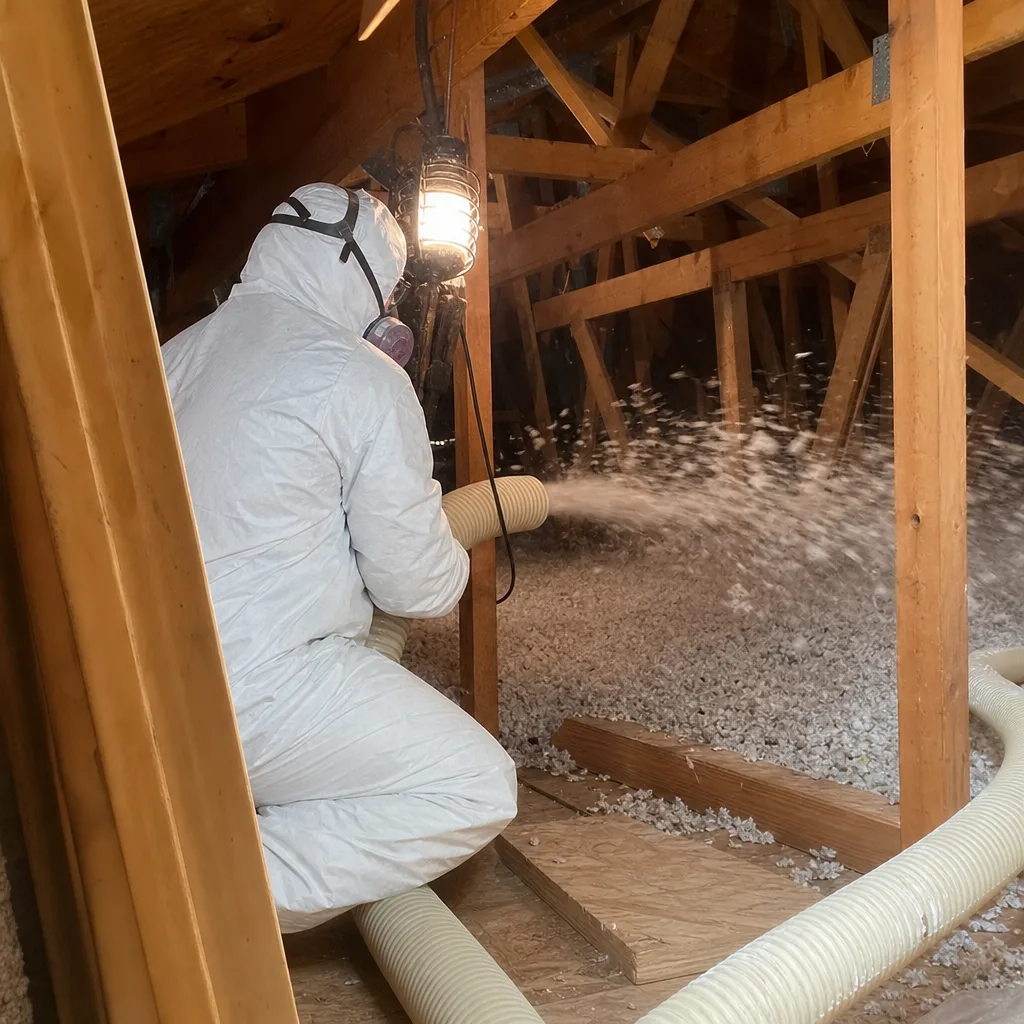
For a typical 1,200-square-foot attic in San Diego, blown-in cellulose to R-38 runs about $1,800. Fiberglass batts to R-38 run about $1,100. Spray Foam Insulation in San Diego on an attic roofline runs $4,000 to $7,000 depending on roof geometry, but it also eliminates most of the air leakage that batt and blown-in jobs leave behind.
We source from manufacturers like Owens Corning, Rockwool, Knauf, and CertainTeed, matched to the job rather than whatever happens to be on the truck that day. The material should fit the microclimate and the house, not the other way around.
How to Read Your Utility Bill as a Diagnostic Tool
Your SDG&E bill tells you more about your insulation than most home inspectors will. Before calling an insulation contractor, pull your last 12 months of usage and look for these patterns:
- Check your summer baseline. If your July or August bill is 2x or more your March or April bill, your attic is working against you. Mild months show your true baseline usage. A sharp summer spike means heat is getting in.
- Look at kilowatt-hours, not dollars. Rates change every year. Usage doesn’t lie. 800 kWh in January and 1,600 kWh in July means your cooling load is the problem.
- Check your time-of-use data. SDG&E’s online portal shows usage by hour. If your home pulls significant power from 2 p.m. to 6 p.m., that’s attic heat radiating down into living spaces during the hottest part of the day.
- Compare your winter floor usage. If your home uses 500 kWh in the mildest month, that’s a sign your building envelope is doing okay but could still be improved. Homes with good insulation and air sealing in San Diego often use 350 to 450 kWh in mild months.
This data gives you a baseline before any contractor visit. It also helps you verify results afterward. If we add R-38 to your attic in May and your July bill drops 20%, you can see it in the numbers. That’s the most honest review there is.
Signs Your Home Is Under-Insulated
Some insulation problems are obvious. Others are subtle enough that homeowners live with them for years without connecting the dots. Watch for these signals:
- Upstairs rooms run 5 to 10 degrees warmer than downstairs in summer. That’s attic heat pressing down through thin ceiling insulation.
- Your AC runs constantly on mild days. If the system can’t hold 75°F when it’s only 80°F outside, the building envelope is the problem, not the AC.
- Rooms feel drafty in January. Air leaks around recessed lights, attic hatches, and top plates let conditioned air escape. Insulation alone won’t fix drafts. You need air sealing too.
- Your attic insulation is visibly thin or compressed. If you can see joists above the insulation level, you’re under-insulated. If it’s gray, dusty, and flattened, it’s lost R-value.
- Moisture or mildew smell in closets or corners. Coastal San Diego homes with poor attic ventilation trap humid air. This is common in Point Loma, Ocean Beach, and Mission Beach homes built in the 1960s and 1970s.
- Pest activity in the attic. Rats and mice love old, settled insulation. If you hear scurrying, the insulation likely needs removal and replacement.
If you check off three or more of these, insulation is costing you money every month. The good news is that fixing it is one of the most straightforward home improvements you can make. Insulation Removal in San Diego is the starting point if your existing material is contaminated, compacted, or full of pest droppings.
Common Mistakes to Avoid
- Treating all San Diego homes the same. A 1930s craftsman in North Park has different needs than a 1990s track home in Rancho Bernardo. The right insulation solution starts with the house’s actual construction, not a generic R-value recommendation.
- Blocking soffit vents with new insulation. This is the most common DIY and low-bid mistake we see. Baffles must be installed before blown-in insulation goes in. Blocked soffits turn a well-insulated attic into a hot, damp box.
- Insulating over old rodent-contaminated material. New insulation over droppings does not solve the problem. The old material should be removed, the attic sanitized, and entry points sealed before new insulation is installed.
- Ignoring air sealing. Insulation slows heat transfer. It doesn’t stop air movement. A house with R-38 in the attic and unsealed recessed lights will still leak conditioned air all day long, and the insulation will turn black from filtered dust within a few years.
- Chasing the highest R-value without addressing ventilation. More insulation in a poorly ventilated attic can trap moisture in marine layer zones and create mold conditions. Balance matters.
- Waiting until the hottest week of August. Insulation contractors in San Diego book out weeks in advance during peak summer. Spring and fall are ideal. You’ll get better scheduling flexibility and your home will be ready before the next heat wave.
When to Call a Professional
Some insulation tasks are straightforward DIY. Others are not. If your attic has existing insulation that needs removal, signs of pest activity, knob-and-tube wiring, or moisture damage, call a professional. Spray foam should always be installed by trained technicians because the chemical reaction, temperature, and expansion rate must be managed correctly. Working in a 140°F attic is also genuinely dangerous, and an experienced crew with proper gear will do in a day what a homeowner struggles through across several weekends. Laurel Attic Insulation San Diego home is our central hub for everything related to insulation in the region. Laurel Attic Insulation San Diego offers free estimates in San Diego. Call (619) 793-3676 and we’ll send a technician to inspect your attic, give you a written price, and walk you through what actually needs to happen.
Frequently Asked Questions
The best insulation in San Diego depends on your microclimate. Coastal homes benefit from moisture-resistant materials and careful ventilation management. Inland valley homes need R-38 to R-49 in the attic, typically blown-in cellulose or fiberglass. Eastern desert fringe homes need R-49 plus radiant barrier. Spray foam is ideal for coastal moisture control and air sealing. Call (619) 793-3676 for a free estimate and we’ll tell you what fits your specific house.
Most attic insulation jobs in San Diego run $900 – $2,400 depending on square footage and R-value needed. Fiberglass batts run $0.50 – $1.00 per square foot installed. Blown-in cellulose runs $1.20 – $2.00. Spray foam runs $2.50 – $5.00. Laurel Attic Insulation San Diego writes a firm price before any work starts, so there’s no door-step surprise.
If your existing insulation is dry, solid, and free of pest contamination, topping it up is cheaper than a full replacement. If it’s compressed, water-damaged, or full of rodent droppings, replacement is the better investment. A full removal and replacement for a typical San Diego attic runs $1,500 to $3,500. Call (619) 793-3676 and we’ll tell you honestly which path makes sense for your house.
Fiberglass batts can last 30 to 50 years if they stay dry and undisturbed. Blown-in cellulose settles over time and loses about 20% of its R-value after 20 years. Spray foam can last the life of the house. In practice, most San Diego homes should be inspected every 10 years and topped up or replaced when signs of settling, moisture, or pest damage appear.
Yes. Homes with R-38 or higher attic insulation consistently show 15% to 25% lower cooling costs than comparable homes with R-19, based on what we’ve seen across hundreds of San Diego retrofit projects. The exact savings depend on your microclimate, roof color, tree cover, and AC efficiency, but the pattern holds.
We answer calls live 24/7. Depending on scheduling, same-day estimates in San Diego are often possible, and you’ll get a live arrival time rather than a vague window. Written price before work starts, every time. Call (619) 793-3676.
The Bottom Line
San Diego’s mild reputation is the reason so many homes here are under-insulated. Builders figured the weather would do the work, and for decades, nobody questioned it. But three distinct microclimates, 150°F summer attics, and rising electricity rates tell a different story. The right insulation, matched to your specific neighborhood and home construction, cuts cooling bills, stabilizes indoor temperatures, and protects against the moisture and pest problems that quietly damage coastal and canyon homes. Laurel Attic Insulation San Diego has been serving San Diego since 2003. We put the price in writing before work starts, guarantee every job for 365 days, and show up when we say we will. Call (619) 793-3676 for a free estimate and we’ll tell you exactly what your home needs, or explore more guides & resources.
Written by Chase Whitaker, Owner at Laurel Attic Insulation San Diego, serving San Diego since 2003.