
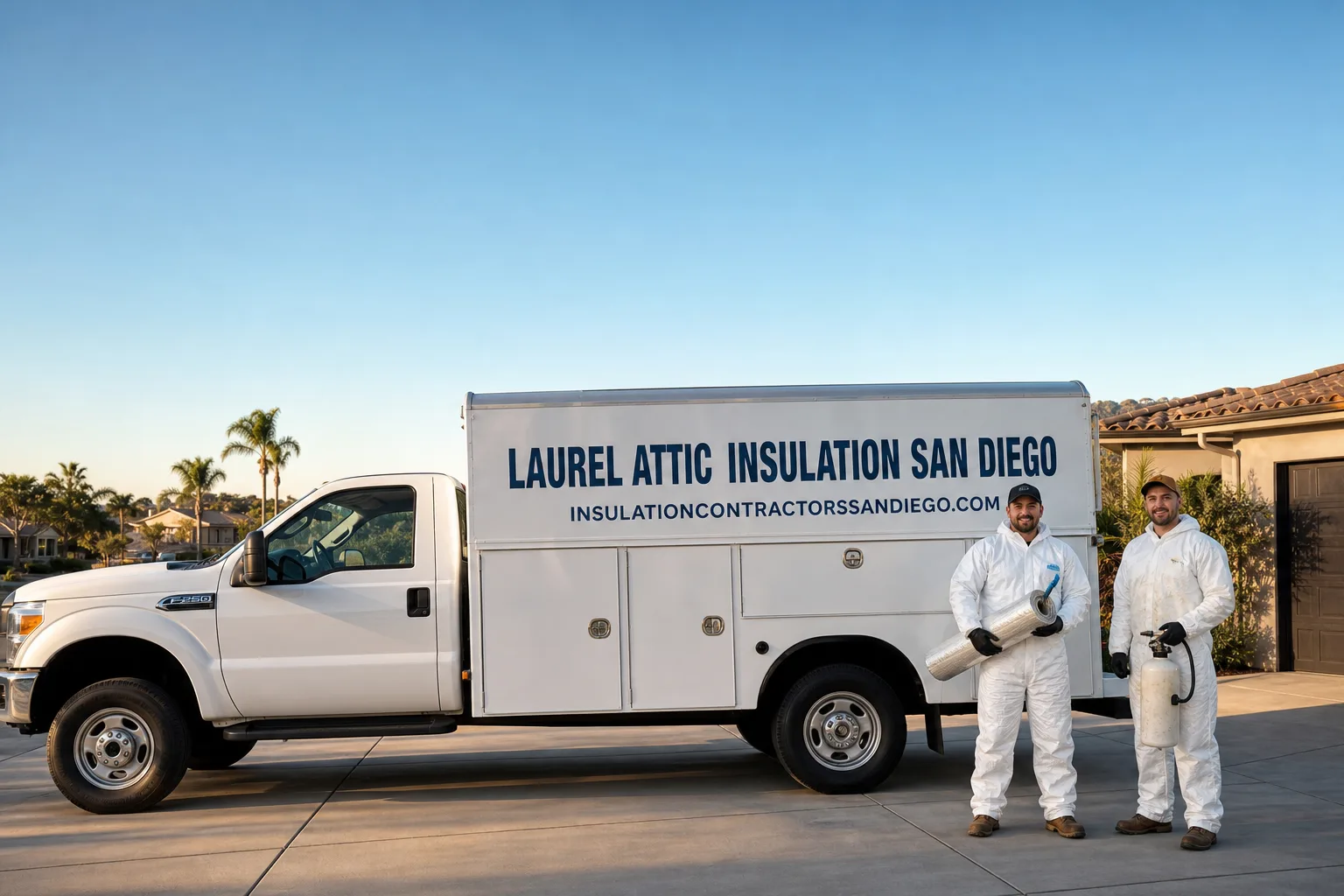
Fast, Reliable Spray Foam Insulation Across San Diego
Spray foam insulation in San Diego typically costs $2,800 – $7,500 for a full attic application, and most jobs are completed in one day. The real question is which foam type your specific microclimate needs. We’ve worked in Ocean Beach bungalows, Clairemont tract homes, and El Cajon ranchers, and the answer changes by ZIP code. Call (619) 793-3676 for a written quote before any work starts.
Why Laurel Attic Insulation San Diego Is San Diego’s Preferred Spray Foam Insulation Company
San Diego homeowners don’t have time for vague four-hour arrival windows or price changes at the door. That’s why every Laurel Attic Insulation job includes our Relay Visibility Guarantee: a written price delivered before work starts, live technician tracking, and before-and-after photo proof. You see exactly what happens, when it happens, and what it cost, all from your phone.
Chase Whitaker leads our San Diego crews, and he’s the one who signs off on every job. Our technicians are background-checked and uniformed, and we answer calls with a live person 24/7. No voicemail queue, no callback tag. Founded in 2003 as part of the Relay Home Co. family, we bring Owens Corning, Icynene, and Demilec materials to San Diego attics daily, matched to the job instead of whatever’s on the truck.
We know San Diego’s split personality: coastal fog in Point Loma, dry heat in Rancho Bernardo, and older housing stock in Allied Gardens that was barely insulated when it was built. That local knowledge changes the foam we recommend and how we install it.
Open Cell Spray Foam in San Diego
Open Cell Spray Foam is a lighter-density foam that expands to fill gaps and air-seals the attic in one pass. It’s what we recommend for most San Diego attics because it handles our humidity better than closed-cell and provides solid R-value per dollar. In a typical 1960s Clairemont home with slumping fiberglass batts, open-cell spray foam restores the thermal envelope and blocks the June Gloom dampness that creeps into older attics near the coast.
Air Sealing and Dampness Control
San Diego’s coastal neighborhoods like Pacific Beach see morning fog and marine-layer dampness for months each year. Open-cell foam acts as an air barrier, not just an insulator. That means less moist air infiltrating your attic space, less mold risk behind knee walls, and fewer drafts through ceiling penetrations.
Retrofit Attic Applications
In older San Diego homes, open-cell foam can be sprayed directly onto the attic floor or roofline after the degraded fiberglass is removed. We typically recommend open-cell for attics in Clairemont and Allied Gardens where ventilation is limited and air sealing matters more than extreme R-value per inch.
Spray Foam Insulation Contractors in San Diego
Spray Foam Insulation Contractors in San Diego are not all the same. We have crews who understand the difference between spraying a 1950s Ocean Beach bungalow with no wall insulation versus a 2015 Otay Ranch build with modern framing. That distinction changes prep work, foam type, and thermal barrier requirements, and it’s why we never treat San Diego as one uniform climate.
Coastal Corrosion and Equipment Care
Salt air near Ocean Beach and Point Loma corrodes unprotected fasteners and degrades improperly applied foam adhesion within five years. Our crews inspect for existing corrosion before spraying and use proper surface preparation so the foam bonds correctly the first time. We also recommend specific fasteners and hardware for unconditioned attics near the coast where salt intrusion is constant.
Inland Heat and Thermal Barriers
Inland San Diego attics in El Cajon and Escondido regularly exceed 150°F in summer. Closed-cell foam applied without a proper thermal barrier can shrink and pull away from rafters under those conditions, and we have seen that failure mode more times than we’d like in our 20+ years serving San Diego. The fix is installation protocol that accounts for extreme attic heat, which not every contractor follows.
Trusted Brands We Service in San Diego
We stock and install materials from Demilec, Icynene, and Owens Corning for San Diego jobs. Each brand has specific strengths: Demilec open-cell for coastal air sealing, Icynene closed-cell for rim joists and garage ceilings where heat gain is extreme, and Owens Corning for retrofit attic applications where airflow matters. We maintain local inventory of these products for fast turnaround in San Diego, so you’re not waiting on a shipping delay from out of state. When we quote a job, we tell you exactly which foam we’re using and why, matched to your microclimate.
Common Spray Foam Insulation Problems We See in San Diego Homes
- Slumped fiberglass in 1950s-1970s tract homes. Clairemont and Allied Gardens homes built between 1955 and 1975 often have original batt insulation that has compressed to R-8 or worse. By noon in summer, those attics hit 130°F, and the upstairs bedrooms become unusable. Spray foam restores the thermal barrier and air-seals the ceiling plane in one day.
- Salt air corrosion in coastal attics. Homes near Ocean Beach and Pacific Beach see marine-layer moisture all year. That salt-laden air corrodes exposed fasteners and degrades improperly applied foam adhesion within five years. We inspect for corrosion before spraying and recommend appropriate surface prep for coastal structures.
- Oversized or poorly placed ventilation in Allied Gardens. Many older San Diego homes have undersized attic ventilation, which can trap moisture when spray foam is added without addressing airflow. We evaluate vent placement and often recommend adding or relocating vents before spraying to prevent mold growth behind knee walls.
- Shrinking closed-cell foam in inland valley attics. El Cajon and Escondido attics hit 150°F+ regularly in summer. Closed-cell foam applied without a proper thermal barrier can shrink and pull away from rafters under that kind of heat. We have corrected this on multiple San Diego jobs, and it’s why we specify installation protocols for inland microclimates.
Pricing for Spray Foam Insulation in San Diego, CA
Here’s what San Diego homeowners can expect to pay for common spray foam applications in 2026:
- Open-cell spray foam attic (full application): $2,800 – $4,200 for a typical 1,200 – 1,800 sq ft single-story home
- Closed-cell spray foam rim joists: $900 – $1,800 depending on linear footage
- Garage ceiling spray foam: $1,200 – $2,400 for a standard two-car garage
- Spray foam roof deck (new construction or cathedral ceiling): $4,500 – $7,500
- Spray foam removal and reapplication: $2,000 – $4,000 including disposal
These ranges reflect San Diego labor rates and material costs. Square footage, foam thickness, and access complexity all move the number. Every Laurel Attic Insulation quote is a written price delivered before work starts, and it includes the 365-Day Done Right Promise: if it’s not right, we make it right, in writing. Call (619) 793-3676 for a free estimate.
We Also Serve Cities Near San Diego
Our spray foam crews work throughout San Diego and neighboring communities. We regularly spray attics in Coronado beach cottages, National City ranchers, Lemon Grove hillside homes, and Bonita’s newer developments. Response time from our San Diego office to these areas is typically under an hour, and we offer live arrival tracking on every job. For more details on our full Spray Foam Insulation service area, give us a call.
Serving San Diego, CA - Our Local Coverage Area
We’re based in the San Diego area and know this community well. Use the map below to see our service coverage - if you’re nearby, we can almost certainly help.
FAQs About Spray Foam Insulation in San Diego
Open-cell spray foam is excellent at blocking the marine-layer moisture that drifts into Pacific Beach and Ocean Beach attics from May through July. The foam creates an air barrier that stops moist coastal air from infiltrating through ceiling gaps and penetrations. Most Pacific Beach homeowners notice less musty attic smell and lower indoor humidity within a week of spraying. Call (619) 793-3676 and we’ll inspect your attic ventilation and give you a written quote.
For a 1960s Clairmont home with no wall insulation, open-cell spray foam is usually the better choice. It air-seals while insulating and handles San Diego’s humidity cycles better than closed-cell in unconditioned attics. If the walls themselves are uninsulated, we typically recommend injecting open-cell foam into wall cavities where accessible, which handles the thermal loss without trapping moisture. The right answer depends on your framing and ventilation, which we evaluate on-site before recommending anything.
Yes, spray foam can significantly reduce cooling costs in El Cajon, where summer attic temperatures regularly exceed 150°F. Most of the heat gain in an El Cajon ranch home comes through the attic into the living space, not through the walls. Air-sealing the attic floor with open-cell foam blocks that heat transfer and reduces AC runtime by measurable amounts. Homeowners we’ve worked with in El Cajon typically see noticeable cooling-load reduction within the first week. We’ll give you a straight answer about payback when we inspect your attic.
No, modern spray foam from brands like Demilec and Icynene is formulated to off-gas minimally and cures within 24 hours. The concern with off-gassing in small spaces like an Ocean Beach bungalow is real but manageable: we recommend ventilating the space for 24 hours after application and not sleeping directly under freshly sprayed attic areas for that day. Proper application by a trained crew eliminates most off-gassing risk. Our technicians are certified for the materials they install and will walk you through the cure timeline before we start.
Spray foam holds up significantly better than fiberglass batts in San Diego’s salt air environment. Fiberglass loses R-value when it absorbs salt-laden moisture from coastal fog, and it tends to slump over time. Closed-cell spray foam is impermeable to moisture and maintains its R-value in Ocean Beach, Pacific Beach, and Point Loma attics. The key is proper application: salt air corrodes improperly protected fasteners and degrades poor foam adhesion within five years. We inspect for existing corrosion before spraying and use proper surface preparation for coastal structures.
Written by Chase Whitaker, Owner at Laurel Attic Insulation San Diego, serving San Diego since 2003.
Ready to get a written price? Call (619) 793-3676 now and we’ll schedule a free estimate with live arrival tracking.